
September 4, 2026
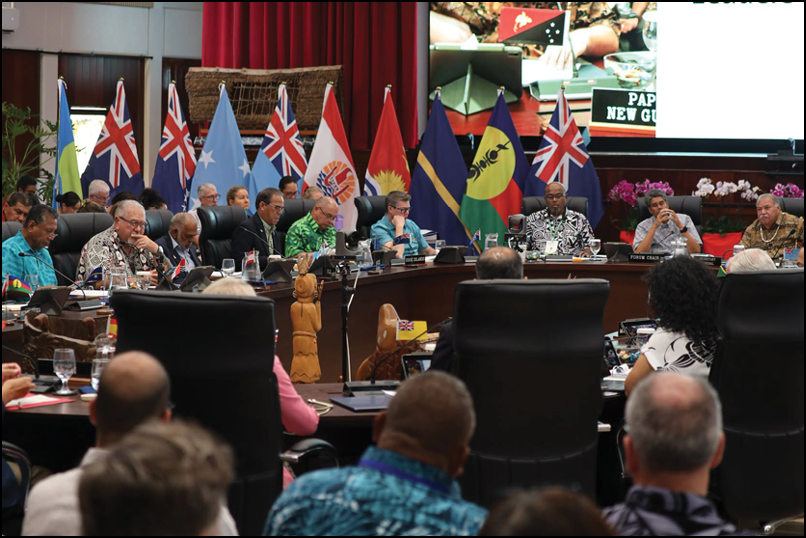
KOROR, Palau — Pacific Islands Forum leaders concluded their annual meeting in Palau with agreements spanning regional security, climate change, economic development, oceans and fisheries, health, renewable energy, artificial intelligence, and the future structure of regional cooperation.
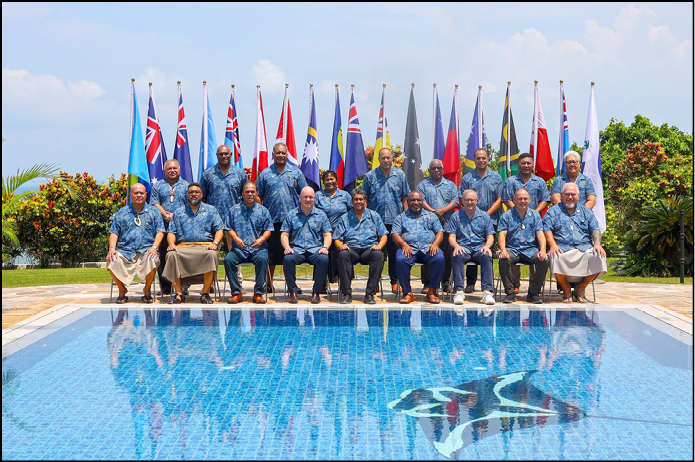
The 55th Pacific Islands Forum, held August 31 through September 3, brought together leaders and representatives of the Forum’s 18 members. FSM President Wesley Simina attended the meeting.
While considerable attention surrounding the meeting focused on geopolitical competition and China’s recent intercontinental ballistic missile test in the Pacific, the 20-page Forum Communiqué adopted at the end of the meeting sets out a much broader regional agenda.
Leaders themselves acknowledged that the Pacific is operating in a period of growing uncertainty involving geopolitical competition, economic volatility, climate threats, and rapid technological change. But they said Pacific priorities must remain at the center of the region’s dealings with international partners.
The communiqué reaffirmed the 2050 Strategy for the Blue Pacific Continent as the region’s long-term framework and said Pacific regionalism rests on the sovereignty of Forum members and their collective right to determine their own priorities, shape their own agenda, and choose their own partnerships.
Leaders also moved forward with changes to the regional architecture intended to improve coordination among Pacific institutions and their ability to carry out decisions. The reforms are to be consolidated into a transition and implementation process extending through 2030.
Regional security occupied a substantial part of the communiqué.
Leaders endorsed the Regional Peace and Security Action Plan 2026-2030 and reaffirmed the Boe Declaration on Regional Security and the Blue Pacific Ocean of Peace Declaration as the region’s principal security frameworks.
They identified geopolitical tensions, transnational organized crime, climate change, economic disruption, and emerging strategic risks among the security challenges facing Pacific countries.
Leaders also agreed in principle to the Waqa Moana Concept, a proposed regional mechanism to strengthen cooperation against organized crime and illicit drug trafficking through intelligence sharing, coordination, and maritime security cooperation. Further consultations will be conducted within individual countries.
A Solomon Islands proposal for a Blue Pacific Ocean of Peace Regional Security Treaty received no final endorsement. Leaders encouraged further consideration of the proposal and said additional consultations were needed.
The communiqué also addressed the recent ICBM test that had generated considerable discussion before and during the Forum.
Rather than identifying China in the final document, leaders expressed concern that the recent test had overflown a number of Forum members without adequate notice.
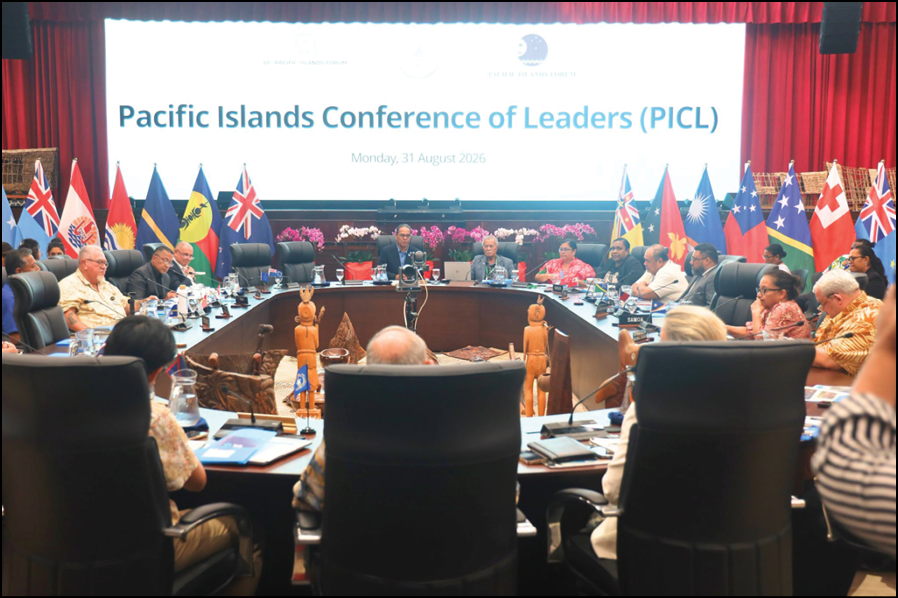
They called on all states conducting ICBM tests to provide at least 24 hours’ advance notification and said such tests should be conducted consistently with the Blue Pacific Ocean of Peace Declaration and Treaty of Rarotonga and with respect for the sovereignty of Forum members.
The Republic of Naoero formally disassociated itself from that paragraph.
The wording followed discussions that had begun before the leaders’ meeting over whether the Forum should issue a statement specifically addressing China’s missile test or establish a broader position applying to missile testing by any country.
At an August meeting of Forum foreign ministers, Secretary General Baron Waqa said members had differing views over whether a statement should focus on the particular incident or apply generally to tests conducted in the Pacific. The matter was left for leaders to consider in Palau.
The final communiqué took the broader approach.
Climate change and energy
Climate change remained one of the clearest areas of regional agreement.
Leaders again described climate change as the single greatest threat to the security, livelihoods, and well-being of Pacific peoples and endorsed the BELAU Declaration for Urgent and Inclusive Climate Action to Keep 1.5°C Within Reach.
The declaration calls for accelerated action to move away from fossil fuels toward renewable energy, improved access to climate finance, greater international recognition of the relationship between oceans and climate, and continued efforts to hold global warming to 1.5°C above pre-industrial levels.
Forum members committed themselves to accelerating development of a regional renewable energy transition strategy aimed at progress toward a 100 percent renewable-energy future while recognizing differing national circumstances.
Leaders also approved terms of reference for a Pacific Renewable Energy Commissioner, to be based within the Pacific Community with reporting arrangements involving both the Pacific Community and Pacific Islands Forum Secretariat.
The Forum endorsed a Pacific Pact on Gender and Climate Action, which calls for greater participation by Pacific women in climate decision-making, better gender-related climate data, and increased access by women and community organizations to climate financing.
Leaders also continued their push to capitalize the Pacific Resilience Facility, describing it as the region’s primary climate-finance investment priority.
The communiqué records that $162 million had been pledged toward the Facility’s initial $500 million capitalization target before the Palau meeting and welcomed additional pledges from Norway, Palau, Papua New Guinea, the Republic of the Marshall Islands, and the United Kingdom.
Oceans and fisheries
The ocean occupied another large portion of the leaders’ decisions.
The Forum endorsed a 2026 Pacific Islands Forum Leaders’ Ocean Statement and reaffirmed previous regional declarations intended to preserve Pacific maritime zones and sovereign rights despite climate change-related sea-level rise.
Leaders called for outstanding maritime-boundary treaties to be completed, existing agreements to be brought into force, and relevant maritime coordinates and charts to be deposited with the United Nations.
They also endorsed the Vakamanu Regional Pacific Fisheries Strategy 2026-2035 as the region’s principal fisheries and aquaculture framework.
The strategy is intended to support sustainable management while protecting members’ sovereign rights and increasing the economic and social benefits Pacific countries receive from their fisheries resources.
On deep-sea minerals, leaders endorsed further work on a member-led regional approach while maintaining that individual countries retain sovereign rights over natural resources within their jurisdictions.
They also renewed calls for a legally binding global agreement addressing plastics throughout their life cycle and for stronger action against illegal, unreported, and unregulated fishing.
The communiqué acknowledged the Pacific Blue Shipping Partnership Charter signed in June by Fiji, the Marshall Islands, FSM, Kiribati, Naoero, Tuvalu, and Vanuatu, and subsequently by Tonga. The initiative is intended to coordinate efforts to decarbonize Pacific shipping.
Leaders also recognized traditional navigation and voyaging as an expression of Pacific culture, identity, and traditional knowledge and welcomed a declaration presented by Palau’s Great Council of Chiefs and the Micronesian Voyaging Society recognizing traditional navigation as cultural heritage of the Blue Pacific Continent.
Economy and development
On economic development, leaders reaffirmed the Pacific Roadmap for Economic Development and called for deeper regional cooperation, greater economic diversification, improved connectivity, and stronger capacity to withstand external economic shocks.
They endorsed the KAVA Declaration, which seeks to protect kava’s Pacific origins, traditional knowledge, and cultural identity while increasing opportunities for Pacific producers in international markets.

Leaders also agreed to establish a regional Labour Ministers Meeting, reflecting concerns over labor mobility, skills development, workforce sustainability, and the economic effects of migration.
People-centered development included commitments involving disability rights, women’s political participation, education, and non-communicable diseases.
The Forum endorsed a refreshed Pacific Framework for the Rights of Persons with Disabilities and urged members to remove structural barriers to participation.
Leaders also expressed concern over the persistently low representation of women in Pacific national parliaments and urged governments to adopt policies and laws intended to increase women’s political participation.
Non-communicable diseases were again identified as a major regional development challenge, with leaders calling for faster implementation of the Pacific NCD Roadmap.
AI, connectivity, and aviation
Artificial intelligence also appeared on the Forum agenda for the first time as the subject of a collective regional position.
Leaders endorsed Pacific Digital and Artificial Intelligence Technology Principles, which are intended to guide development of the Pacific’s first AI governance framework for consideration in 2027.
The communiqué says AI should remain human-centered, inclusive, and aligned with Pacific values. Leaders called for safeguards for Pacific languages, cultures, and traditional knowledge and said AI governance should include transparency, accountability, safety, and meaningful human oversight.
The Forum also recognized the importance of cybersecurity and digital sovereignty and supported development of a regional approach to online harms, including the effects of social media and technology-facilitated violence on children, young people, women, and other vulnerable groups.
Leaders welcomed what the communiqué described as the achievement of having all Forum members connected to undersea telecommunications cables for the first time.
They also supported continued implementation of the Pacific Regional Aviation Action Plan and development of a Pacific Regional Aviation Framework, with particular attention to improving connectivity for smaller island states.
Forum meetings through 2031
The communiqué confirmed Forum hosts for the next five years.
New Zealand will host the 56th Pacific Islands Forum Leaders Meeting in 2027, followed by Naoero in 2028, the Republic of the Marshall Islands in 2029, Vanuatu in 2030, and French Polynesia in 2031.
For Palau President and Forum Chair Surangel Whipps Jr., however, the importance of the meeting would ultimately be measured by what followed it.
At the closing of the Forum, Whipps said the test would be whether regional decisions resulted in tangible improvements for Pacific people.
“Alone, each of us faces immense challenges,” Whipps said.
“Together, we can secure our energy future, protect our oceans, build economies that serve our people and ensure that the Pacific remains the author of its own destiny.”
Leave a Reply