
The European Union and UNICEF announce a major agreement to strengthen education systems and climate-resilient school infrastructure across the Pacific during the 55th Pacific Islands Forum Leaders Meeting in Palau
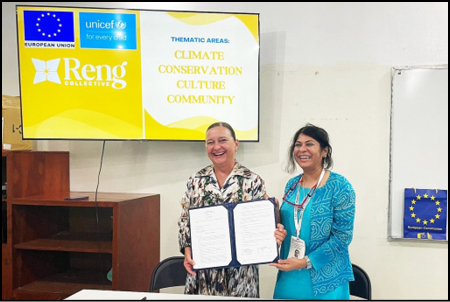
Across the Pacific, climate change is increasingly damaging schools and disrupting children’s education. Almost every year, cyclones, floods, rising sea levels – amongst other disasters – damage classrooms, water systems, and school facilities, particularly in remote communities. In many cases, schools are repaired only to be damaged again by the next disaster, leading to a costly cycle of damage and reconstruction.
The new €17 Million Pacific Climate Resilient Education Systems (Pacific CRES) programme signed and launched at a side event of the 55th Pacific Islands Forum Leaders Meeting in Palau, reflects the European Union’s (EU) long-term commitment to working alongside Pacific countries and UNICEF on shared climate and development priorities.
The new programme will upgrade existing school infrastructure, strengthen maintenance systems, as well as introduce practical solutions that help schools remain operational during and after disasters.
Improvements will include climate-resilient water and sanitation facilities, renewable energy systems, and enhanced connectivity – creating safer, more reliable learning environments for children.
The agreement signed yesterday by the Deputy Director-General for the Directorate-General for International Partnerships, Marjeta Jager, and UNICEF Pacific’s Deputy Representative, Roshni Basu, is not only an investment in school buildings. It is an investment in safety, continuity of learning, dignity, and opportunity for children and communities facing growing climate and disaster risks.
In addition to improving school infrastructure, the programme will support governments to plan and budget for the long-term maintenance of school facilities.
“Launched during this Pacific Islands Forum Leaders Meeting, and in the same year that the Pacific hosts pre-COP, the partnership reflects growing recognition that climate resilience must be built into the systems and services that children rely on every day,” said UNICEF Pacific’s Deputy Representative, Roshni Basu. “With the leadership of Pacific governments and in partnership with the European Union, this programme is investing in solutions that will protect learning for years to come, rather than relying on short-term fixes.”
Over the next five years, the programme is expected to directly benefit around 15,000 children through improved school facilities in Fiji, the Federated States of Micronesia (FSM), Kiribati, and Solomon Islands. It will support approximately 2,000 teachers and school administrators with training on disaster preparedness and school resilience. It will also engage around 25,000 community members in disaster risk reduction and school maintenance activities.
Leave a Reply