
September 9, 2026
NEW YORK — The Federated States of Micronesia has called for stronger cooperation among developing countries as they confront climate change, rising debt, rapid technological change, and other challenges that often fall most heavily on small island nations.
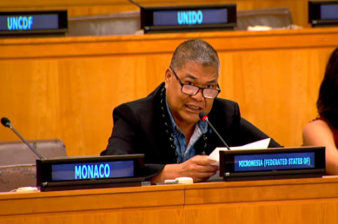
FSM Permanent Representative to the United Nations Jeem Lippwe delivered the message September 11 during a high-level panel discussion in New York for the United Nations Day for South-South Cooperation.
Lippwe said the concept of countries sharing knowledge, experience, and solutions has particular relevance for Small Island Developing States, where climate change remains an existential concern.
“Across the Global South, solidarity is rising,” Lippwe said. “Countries are exchanging knowledge, adapting proven approaches, and scaling innovations that improve lives.”
He said that cooperation is taking place against what he described as a difficult international environment characterized by rising debt burdens, climate-related disasters, rapid digital transformation, and growing uncertainty.
“For Micronesia, climate change remains an existential concern, threatening the security, livelihoods, and resilience of our communities,” Lippwe said. “In such a context, South–South cooperation is indispensable.”
South-South cooperation generally refers to developing countries exchanging resources, knowledge, technology, and expertise to address shared development challenges. Lippwe said the FSM’s own experience demonstrates how such partnerships can be translated into practical programs addressing nationally identified needs.
He specifically thanked India for its support through the India–UN Development Partnership Fund, which finances development projects proposed and led by countries of the Global South.
According to Lippwe, the FSM is benefiting from a group of initiatives supported through the fund that address clean energy, climate preparedness, inclusive institutions, gender equality, and access to health services across the nation’s islands.
“These efforts support our transition to clean energy, strengthen climate preparedness, reinforce inclusive institutions and gender equality, and expand access to essential health services across our islands,” he said.
Lippwe described those programs as examples of cooperation in which experiences and solutions developed elsewhere are adapted to local circumstances rather than imposed through a single model.
He said South-South cooperation ultimately extends beyond physical infrastructure and technology.
“They demonstrate that cooperation is not only about infrastructure or technology; it is fundamentally about people, about resilience, opportunity, and dignity,” Lippwe said.
The FSM also welcomed the launch of the Global Alliance for South-South and Triangular Cooperation, which is intended to provide a platform through which countries can connect development solutions, establish partnerships, and expand successful initiatives.
Triangular cooperation generally brings a third partner — such as an international organization, developed country, or other development partner — into cooperation between developing countries, providing additional resources, expertise, or institutional support.
The theme of this year’s UN observance was “Solidarity Rising: Global Alliance for Inclusive and Innovative Development.”
Lippwe said the theme reflects the circumstances facing Small Island Developing States, where many of the most serious development and climate challenges cross national boundaries and cannot readily be addressed by individual countries acting alone.
“Our challenges are shared, and our solutions must be shared as well,” he said.
Lippwe said the FSM remains committed to strengthening partnerships, exchanging solutions, and contributing to broader development efforts through cooperation among countries of the Global South.
Leave a Reply