
September 30, 2026
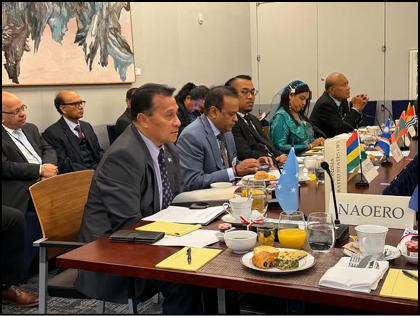
NEW YORK — FSM Vice President Aren B. Palik called for accelerated efforts to reduce methane emissions during a meeting of leaders of the Alliance of Small Island States (AOSIS) in New York, arguing that near-term reductions could help slow warming while vulnerable island communities adapt to climate impacts already underway.
Palik participated in the 2026 AOSIS Leaders’ Meeting on September 25 during the United Nations General Assembly High-Level Week, joining heads of state and government from Small Island Developing States (SIDS).
The meeting reviewed progress since the 2025 AOSIS Leaders’ Declaration on the Special Circumstances of SIDS and considered priorities for several upcoming international processes. Those include COP31, the first Conference of the Parties to the Agreement on the Conservation and Sustainable Use of Marine Biological Diversity of Areas Beyond National Jurisdiction, commonly known as the BBNJ Agreement, and the 2027 Sustainable Development Goals Summit.
According to FSM Information Services, Palik told the meeting that climate change is already a lived reality for Micronesia and other island nations.
He cited sea-level rise, saltwater intrusion, coastal erosion, and increasing threats to food and water security, saying their effects extend beyond the environment to the culture, security, and long-term continuity of island peoples.
Palik urged AOSIS to continue pursuing long-term international climate negotiations while placing greater emphasis on measures that can have an impact in the nearer term.
In particular, he advocated methane mitigation as a practical means of slowing warming over the coming decades while countries continue working toward deeper and sustained reductions in greenhouse-gas emissions.
Palik said every fraction of a degree of warming matters to vulnerable island states and called for faster reductions in methane emissions through existing measures in the fossil-fuel, waste, and agricultural sectors.
According to the FSM release, such reductions could give island communities additional time to strengthen their resilience and adapt to climate impacts already affecting homes and livelihoods.
Palik also called for a unified AOSIS position on methane mitigation, arguing that such a position could strengthen the organization’s advocacy for climate measures that can be implemented immediately.
The FSM said it is prepared to work with other AOSIS members and international partners to elevate methane mitigation as a component of the group’s climate advocacy leading into the next Conference of the Parties.
Read or download the complete issue of The Kaselehlie Press

Leave a Reply