
September 30, 2026
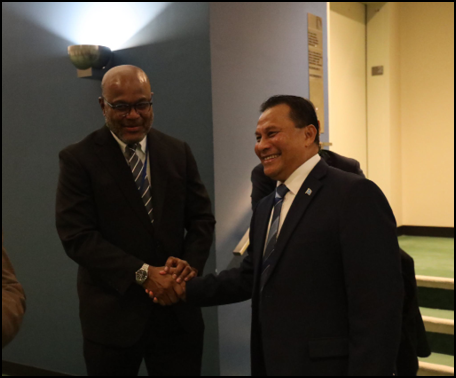
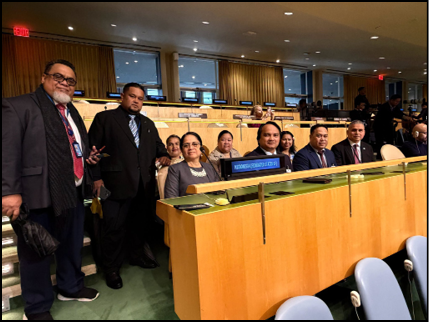
NEW YORK — FSM Vice President Aren Palik used the Federated States of Micronesia’s address to the 81st United Nations General Assembly to call for stronger international action on climate change, ocean protection, renewable energy, development financing, health, migration, and reform of the United Nations.
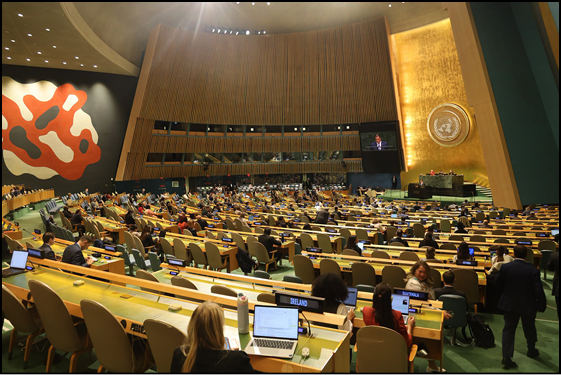
Speaking during the UN General Debate in New York on September 26, Palik said the session’s theme, “Restoring trust, managing transformation: A United Nations that delivers for all,” directly reflects the challenges confronting small island countries.
“We need the benefits of digital innovation, artificial intelligence, energy transition, and institutional reforms,” Palik said. “At the same time, we recognize the challenges of climate change, ocean degradation, pollution, and growing inequality.”
Climate change featured prominently throughout the FSM statement, with Palik describing its effects not simply as an environmental problem but as a security issue.
“Today’s security landscape is shaped not only by conflict but by climate-driven fragility,” he said. “Extreme weather events, sea-level rise, and resource degradation are eroding stability across vulnerable regions, especially the Pacific.”
Those pressures, he said, are increasing humanitarian needs, disrupting food and water systems, and straining governments.
“For Micronesia, climate impacts are a national security concern.”
Palik called for science-based emissions reductions, stronger national climate commitments, a faster transition to renewable energy, and accessible and predictable grant financing for climate adaptation. He also called for the Loss and Damage Fund to be put into operation and for the international community to maintain the goal of limiting global warming to 1.5 degrees Celsius.
The FSM also endorsed the proposed Fossil Fuel Non-Proliferation Treaty.
“Shift to renewable energy is an economic necessity,” Palik said. “Solar, wind, and ocean-based technologies can reduce dependence on external fuel markets, strengthen energy security, and lower emissions in line with science.”
He said instability in the Middle East and volatile fuel prices have demonstrated the vulnerability of Small Island Developing States to expensive fuel and unstable supplies.
Maritime security and protection of the Pacific Ocean were another major focus of the address. Palik said illegal, unreported, and unregulated fishing, transnational crime, and environmental degradation threaten both Pacific economies and the marine environment.
He called for greater international cooperation, technology sharing, and capacity-building “to ensure that the ocean remains a zone of peace, governed by international law.”
“The ocean is the heart of Micronesian identity, livelihoods, and future prosperity,” Palik said. “It faces mounting pressures from climate change, sea-level rise, pollution, and unsustainable exploitation.”
Palik pointed to the FSM’s involvement in implementing the Agreement on the Conservation and Sustainable Use of Marine Biological Diversity of Areas Beyond National Jurisdiction, commonly known as the BBNJ Agreement. He said Micronesia, which was the first country to sign the agreement, is among six countries moving toward implementation and is working with GIZ and five co-leading states to develop area-based management tools and marine protected area proposals.
On deep-sea mining in the international seabed area, Palik said the FSM is taking a precautionary approach.
“We stress the need to consolidate comprehensive knowledge, data, and science about the marine environment before any decision is taken on proceeding with exploitation,” he said.
Palik said adjacent coastal states, Indigenous Peoples, and local Pacific communities must also be meaningfully consulted before any such decision.
Plastic pollution was also singled out as a growing threat to Pacific ecosystems and communities. Palik said marine debris, microplastics, and toxic substances are accumulating along island shores, placing disproportionate cleanup and economic burdens on small island governments.
He cited Chuuk Lagoon as an example of another form of marine pollution, saying oil leaking from World War II remnants continues to threaten livelihoods following an emergency declaration last year.
“Micronesia calls on the international community to match local action with global responsibility,” Palik said, calling for sustained funding, technology transfer, tighter controls on plastic production, an end to waste exporting, and completion of an international treaty addressing plastic pollution.
Palik also used the UN address to announce the adoption of the FSM’s National Migration Policy, developed with technical support from the International Organization for Migration.
“Our people are the most valuable national resource,” he said.
The policy, he said, is intended to strengthen protection, engagement, and well-being for FSM citizens, including members of the diaspora. He also said the FSM aligns itself with the Global Compact for Safe, Orderly and Regular Migration.
Health challenges received particular attention. Palik said increasingly frequent tropical storms, heat waves, and changing tidal patterns are affecting public health, while illnesses associated with marine life and vector-borne diseases, including dengue and Zika, are increasing.
At the same time, he said, non-communicable diseases continue to strain the health system and reduce workforce productivity.
“We are strengthening our national health capacity, increasing investments in diagnostics and life-saving medicine, expanding the use of tele-health to access specialist care and medical education, and partnering with neighboring countries to support regular medical exchange programs that augment our treatment capability in-country,” Palik said.
The Vice President also addressed the Sustainable Development Goals, warning that climate impacts are eroding development gains across the Pacific. Recent typhoons, severe flooding in FSM states, and increasingly frequent king tides on low-lying islands demonstrate that such events are becoming recurring pressures rather than isolated emergencies, he said.
Palik called for implementation of the Multidimensional Vulnerability Index as a means of giving Small Island Developing States fairer access to concessional financing based on their structural vulnerabilities.
The address also covered gender equality and youth development. Palik said the FSM is working to address barriers to women’s leadership, economic participation, access to justice, digital safety, and protection from violence, particularly in remote and outer-island communities.
He said young people are increasingly involved in community advocacy, climate stewardship, adaptation, mitigation, and public service, while the country needs to expand skills training, employment opportunities, youth participation in decision-making, and efforts addressing substance abuse and mental health.
Palik also addressed proposed reforms within the United Nations. He said the FSM strongly supports the UN80 reform initiative but stressed that the UN Multi-Country Office and Resident Coordinator system should remain in place because of the FSM’s widely dispersed geography and remote communities.
“For countries defined by distance, dispersion, and vulnerability, reform cannot be an abstract exercise; it must strengthen the UN’s ability to deliver where the needs are greatest,” he said.
On reform of the UN Security Council, Palik said the FSM supports permanent membership for Brazil, Germany, India, and Japan, permanent representation for Africa, and a dedicated non-permanent seat for Small Island Developing States.
The Vice President also addressed digital transformation and artificial intelligence, saying both offer opportunities for improved public services, economic diversification, expanded market access, and climate-resilient development. However, he warned that without adequate investment, capacity-building, and governance, those technologies could increase inequality and exposure to cybersecurity threats, misinformation, and data privacy risks.
Palik concluded by arguing that the issues raised in the FSM statement ultimately test whether the United Nations can produce tangible results for countries such as Micronesia.
“For Micronesia, success must be measured not by declaration, but by tangible improvements in our people’s lives, security, and dignity,” he said.
“We call for equitable partnership with small island developing States through accessible finance, technology transfer, stronger capacity, and meaningful voice in global decisions. In the spirit of KAMORALE, let us choose cooperation over division and build a peaceful, just, and sustainable future in which every nation can thrive.”
Read or download the complete issue of The Kaselehlie Press

Leave a Reply