
August 24, 2026
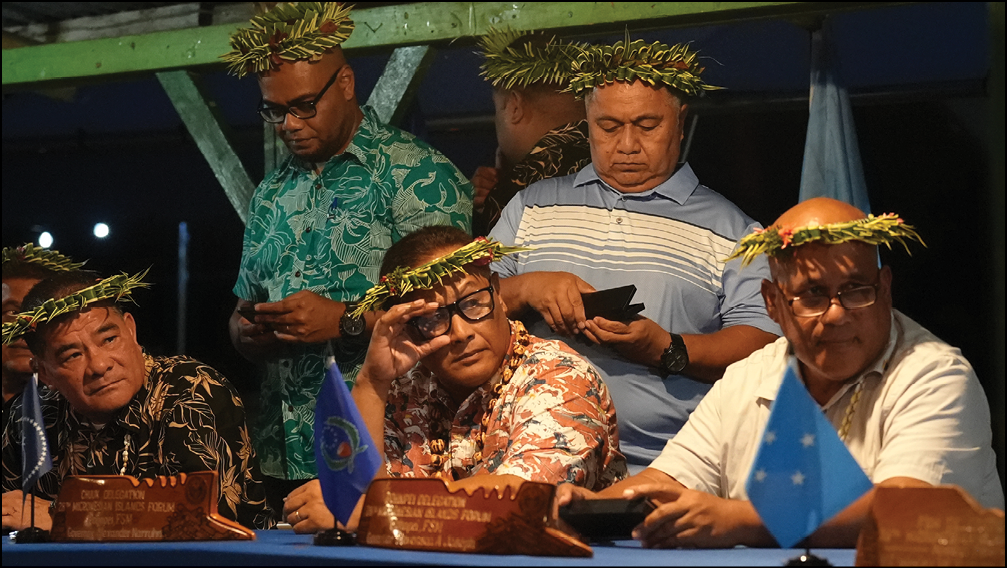
Pohnpei — Leaders of the Micronesian Islands Forum concluded their 28th annual meeting in Pohnpei with a broad set of agreements aimed at some of the region’s most persistent problems, including high fuel costs, limited transportation, shortages of health workers, non-communicable diseases, climate change, telecommunications resilience and barriers to regional trade.
The Forum, held August 19-21 brought together leaders or representatives of the Federated States of Micronesia and its four states, the Republic of the Marshall Islands, Palau, Naoero, Guam and the Commonwealth of the Northern Mariana Islands.
Pohnpei Governor Stevenson A. Joseph served as chairman of the 28th MIF, succeeding Marshall Islands President Hilda C. Heine as chair.
The leaders adopted a 19-page joint communiqué and 10 resolutions, several of which move beyond general expressions of regional cooperation by establishing working groups, directing committees to pursue specific initiatives or committing the Forum to coordinated advocacy.
Among the more immediate economic issues was the continuing regional fuel crisis.
The leaders endorsed establishment of a Micronesia Petroleum Procurement Working Group to determine whether jurisdictions could reduce costs and strengthen fuel security by purchasing petroleum collectively.
The proposal stops short of committing members to a regional fuel-buying arrangement. Instead, the working group is to examine whether coordinated or aggregated procurement is technically, economically, legally and commercially feasible.
The initial group would include representatives from the FSM, Marshall Islands and Naoero, with other MIF jurisdictions able to participate voluntarily.
The Forum called for technical assistance from the Pacific Community, the Pacific Region Infrastructure Facility and other partners to analyze such issues as regional fuel demand, storage, shipping routes, fuel specifications, legal and regulatory requirements, financing and procurement.
The working group is to report back to leaders with a preliminary feasibility assessment and recommendations on whether and how a regional petroleum procurement system should proceed.
The initiative follows concern throughout the meeting about Micronesia’s vulnerability to fuel-price volatility, shipping disruptions and the relatively weak negotiating position of small island markets purchasing petroleum individually.
Transportation emerged as a closely related concern.
Leaders called for stronger regional air and maritime connectivity, saying limited and expensive transportation restricts tourism, trade, healthcare access and economic development.
The Regional Tourism Committee identified costly and limited air access as a major obstacle to tourism and reported establishment of a Regional Air Service Committee intended to improve coordination.
On maritime transportation, leaders noted high shipping costs, delays and limited service options, and supported further examination of a regional shipping vessel and other measures intended to make maritime services more reliable and affordable.
Health occupied a substantial portion of both the communiqué and the resolutions adopted by leaders.
The Forum reaffirmed the 2010 Pacific Island Health Officers Association declaration of a regional health emergency over non-communicable diseases and called for NCD prevention and response to become more closely integrated into local and regional emergency preparedness.
Leaders called for increased prevention efforts among children and young people, including improved nutrition, physical activity, childhood obesity prevention, HPV vaccination and screening.
A separate resolution made oral health a regional priority and called for greater investment in dental services and infrastructure. Leaders also supported stronger surveillance, laboratory diagnostic capacity, border protection, early-warning systems and biosecurity measures to prepare for emerging health threats.
The Forum also turned to one of the region’s longstanding health problems: the shortage and movement of qualified healthcare workers.
Leaders supported creation of a Regional Health and Social Services Workforce Development Cross-Jurisdictional Committee to review professional licensing, certification and credentialing requirements and identify opportunities for reciprocal recognition of qualifications between jurisdictions.
They also backed coordinated advocacy to the U.S. government for permanent removal of the federal Medicaid funding cap applying to Guam and the CNMI.
For veterans in the Freely Associated States, leaders supported proposed U.S. legislation intended to expand healthcare access through telehealth and telemedicine, postal pharmacy delivery, coverage for eligible medical-referral travel and visits by Veterans Affairs physicians.
The communiqué also records interest in exploring collective regional purchasing of medicines and medical supplies to obtain better prices, as well as renewed consideration of a regional health insurance mechanism.
Deep-seabed mining, an issue on which Pacific governments hold sharply different positions, produced a deliberately cautious resolution.
Rather than taking a collective position for or against mining, leaders called for meaningful, science-based regional dialogue and said potentially affected Micronesian jurisdictions should be given relevant scientific information and meaningful opportunities to participate when proposed mining activities could affect them.
The resolution acknowledges Guam’s call for a precautionary pause on deep-sea mining pending sufficient independent science and regional engagement while explicitly recognizing that members hold differing views.
Leaders also reaffirmed protection and sustainable stewardship of the Pacific Ocean for present and future generations.
Climate change produced another regional resolution.
The Forum described climate change as a continuing and urgent regional priority and endorsed the continuing role of the Regional Climate Change Committee in coordinating policy, information sharing and regional priorities.
Among other measures, leaders supported continued collective action on sea-level rise, maintaining the 1.5-degree temperature target and curbing methane emissions. They also called for greater cooperation in obtaining climate finance, technical assistance, capacity building and technology.
Regional telecommunications and digital infrastructure were also addressed.
Leaders reaffirmed work toward the Micronesia ICT and Digital Transformation Action Plan, including redundant fiber routes, satellite backup, disaster-recovery capacity and improved connectivity for remote and underserved communities.
The Forum supported stronger cybersecurity legislation, policies and institutional capacity, along with legal and regulatory frameworks intended to protect government systems, private networks, infrastructure and network-connected public services.
Leaders also supported further assessment of regional data hosting and data-center capacity, including the possibility of sustainable and climate-conscious facilities supported by reliable and renewable energy.
Fisheries discussions included support for Guam and the CNMI in seeking greater opportunities to develop commercial fisheries.
The Forum encouraged consideration within the Western and Central Pacific Fisheries Commission framework of mechanisms including Pacific Insular Area Fishing Agreements, quota arrangements and conservation and management measures that could provide Guam and the CNMI with greater access to highly migratory fisheries while maintaining sustainable management.
The communiqué said Western and Central Pacific tuna stocks remain generally healthy but warned that climate-driven changes in tuna distribution could threaten fisheries revenues and long-term regional benefits.
Leaders also moved to formalize the role of young people within the Forum.
A resolution provides for youth participation within MIF standing committees, with youth representatives able to organize and distribute their participation among committees under their respective terms of reference. Implementation is to begin by the next Forum.
The decision followed presentations by Micronesian youth during the Pohnpei meeting and builds on youth participation recognized at the previous MIF.
Changes are also coming to the Forum itself.
The MIF Secretariat reported available funds of $819,845 and continuing difficulties involving access to a $400,000 U.S. Department of the Interior grant administered through the Guam government.
Leaders approved increasing annual MIF membership dues from $15,000 to $20,000 beginning in 2027 and supported efforts to obtain additional development-partner funding.
They deferred broader proposed amendments to the MIF Rules of Procedure until the next Forum to allow members additional time for review and consultation.
The proposed reforms include procedures for recruiting an independent, dedicated Secretary General and changes to the Forum’s standing committee structure. Leaders also asked designated representatives to examine creation of a steering committee that could improve continuity between past, current and future MIF chairs.
The communiqué reflects an effort to consolidate some of the Forum’s numerous standing committees, which leaders said have overlapping mandates.
Other regional issues considered during the meeting included recycling and waste management, invasive species, gender equality, workforce development, the Micronesia Challenge, regional security, tourism, education, trade and civil-society participation.
Leaders called for education and training to be more closely tied to regional workforce needs as Micronesian jurisdictions confront shortages of technical professionals and continued migration of skilled workers overseas. The Forum supported development of a regional workforce strategy, a centralized system for tracking skills and vacancies, and increased investment in vocational and digital training.
The leaders also said Micronesia should approach the upcoming Pacific Islands Forum meeting in Palau with a unified voice on issues affecting the region.
The 28th MIF communiqué was signed by the delegations of Palau, the Marshall Islands, FSM, Naoero, Pohnpei, Chuuk, Kosrae, Yap, Guam and the CNMI and formally adopted in Pohnpei on August 21.
The meeting’s agreements now move largely to the Forum’s Secretariat, standing committees and member governments for implementation, feasibility studies and further negotiation, meaning several of the initiatives endorsed in Pohnpei — including regional petroleum purchasing, health workforce mobility, transportation improvements and digital infrastructure — remain proposals whose practical and financial viability has yet to be determined.
Leave a Reply