
August 26, 2026
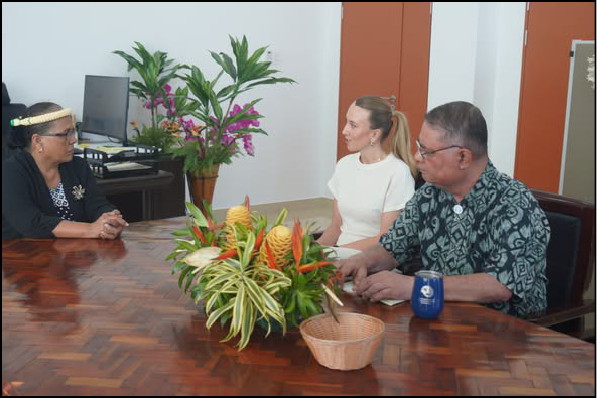
Pei Lapalap, Pohnpei – An autism specialist, Kristin Bartlett, from the World Bank paid a courtesy call on Acting Governor Herolyn S. Movick to discuss strengthening support systems for children with autism and their families in Pohnpei.
During the meeting, the World Bank expert outlined her ongoing scoping mission in the Federated States of Micronesia, explaining that the visit follows formal requests from both the Marshall Islands and FSM to extend World Bank support to autism and related developmental needs. The mission focuses on listening to families, engaging with education and health sectors, and mapping out how best to coordinate services for children with autism.
Acting Governor Movick underscored that autism has become an increasingly visible and important issue for the State, noting that existing education laws already guarantee every child, including those with special needs, the right to attend school from early childhood through the highest level they can reach. She highlighted that, while some well-known organizations are active, many school-based support groups and early childhood programs remain less visible, even though they serve large numbers of children.
The World Bank expert reported that, during her week-and-a-half in FSM, she has been working closely with the Division of Special Services under the Department of Education, conducting school visits, meeting teachers and parents, and consulting with public health, maternal and child health, psychologists, and pediatricians. A key focus is strengthening clear referral pathways so that when parents first notice developmental differences in their children, they know where to go and how to access screening and educational support.
Because external services such as occupational and speech therapy are currently limited, the expert emphasized that schools are the primary environment for support. Planned activities include teacher workshops, in‑service training, classroom coaching, and tools to help educators develop individualized education programs (IEPs) tailored to each child’s strengths, needs, and age.
Acting Governor Movick stressed that training for both teachers and parents is critical. She shared personal examples of autistic children within her own family, emphasizing that many children on the spectrum have exceptional talents in specific areas and can become productive members of society if their strengths are recognized and nurtured.
Acting Governor Movick highlighted that families and teachers need support “to recognize what these children are good at and help them develop in those areas so they can grow into independent, working adults.”
Both parties agreed on the importance of shifting language and attitudes around autism, moving away from terms such as “disability” and “treatment,” which imply a disease to be cured. Instead, they affirmed autism as a lifelong condition that requires support, not a cure, and noted that more positive, accurate language can help reduce stigma and encourage families to seek help.
The meeting also referenced a report prepared by Australian volunteers containing recommendations for the Autism Act. The expert will seek access to this report, currently held by the Director of Health, to help inform ongoing work under the ASPIRE project, which is scheduled to run until June next year.
Before concluding, the World Bank expert committed to preparing a brief aide-mémoire after each mission to update the Pohnpei State leadership on key activities and findings, and to notify the Acting Governor’s Office of future visits. Acting Governor Movick, in turn, expressed appreciation for the World Bank’s support and reiterated the State’s commitment to ensuring that program benefits reach families and schools at the community level, rather than remaining only at the national level.

Leave a Reply