
September 16, 2026
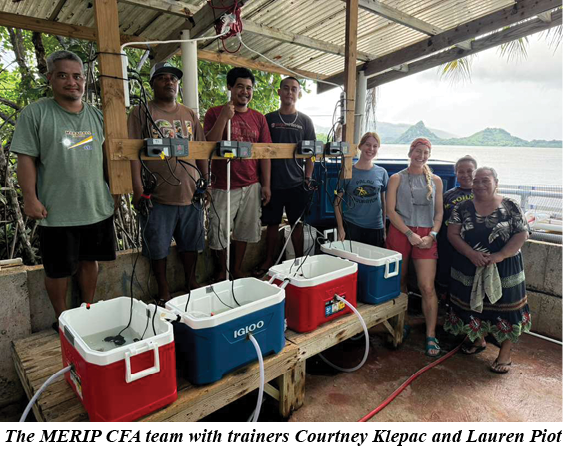
The Marine and Environmental Institute of Pohnpei (MERIP), based at the old PATS campus, has joined The Nature Conservancy, the Conservation Society of Pohnpei, the Marshall Islands Conservation Society, and the Palau International Coral Reef Center in a region-wide project to identify corals that can withstand hotter ocean water caused by climate change and grow these heat-resistant corals for reef restoration.
In a shallow area of Pohnpei lagoon, 132 heat resistant corals have already been planted on four nursery tables. These super corals look exactly like other corals in the lagoon, but they have survived a short heat stress experiment. During the weekly experiments, 24 corals of the same species are put through a four-day boot camp where the water temperature is raised each day. The fragments that survive are planted on tables according to how heat tolerant they are; being scored as either “high” or “medium”-heat tolerant. Importantly, they will be used to restock Pohnpei’s reefs if large-scale coral losses occur in the future.
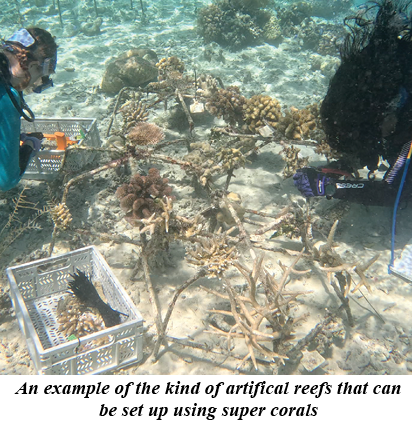
Present El Niño and future ocean conditions across the Pacific are predicted to cause severe coral loss across the region’s reefs, and as a result would reduce inshore fish stocks for Pohnpei’s fishers. The work will therefore give MERIP a supply of corals to rebuild lagoon reefs using corals that have a fighting chance.
The project, called the Coral Futures Academy (CFA), is taking place across Micronesia and works directly with local conservation organizations. It is headed by Dr. Courtney Klepac of Stanford University, with support from Lauren Piot of the Palau International Coral Reef Center. The work is funded by the G20 Coral Research and Development Accelerator Platform, known as CORDAP, through a contract with The Nature Conservancy.
Piot said the project aims to identify, protect and manage coral reefs that are resistant to rising ocean temperatures. It will give local communities the training, resources, skills and knowledge to lead climate-smart coral restoration activities.
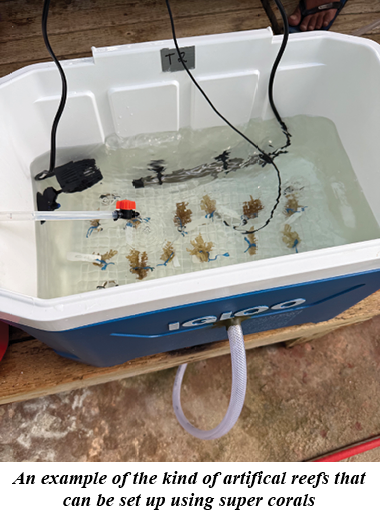
The heat testing experiment uses cheap, readily available materials, including ice chests and aquarium heaters, and can be set up in remote places. “We want to have as many people involved in this process as possible,” Klepac said. “In the future”, she added, “communities may use this framework to restore their own reefs, train other islanders, and even provide jobs in marine stewardship.”
Leave a Reply