
October 16, 2026
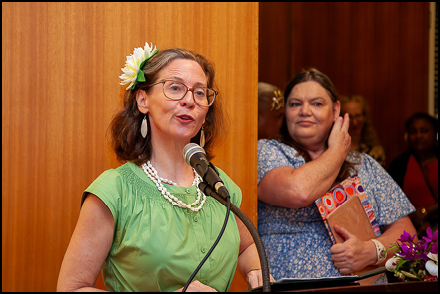
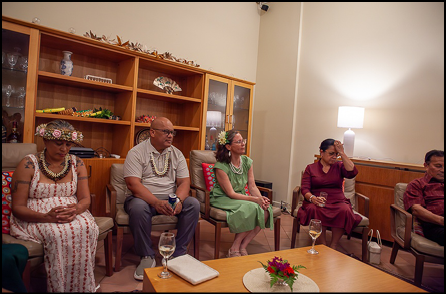
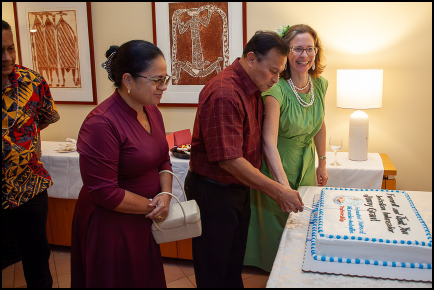
Pohnpei, FSM—Australian Ambassador to the Federated States of Micronesia Jenny Grant hosted a farewell reception at her official residence on October 15, bringing together national and state government officials, members of the diplomatic corps, representatives of international organizations, embassy staff, and friends to celebrate her service and the relationships she developed during her posting.
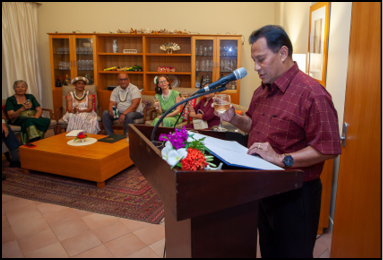
FSM Vice President Alik B. Alik, speaking on behalf of President Wesley W. Simina and the national government, thanked Grant for her contributions to the relationship between the two countries. Australian Third Secretary Josh Critchley also spoke, offering a personal tribute to her leadership and mentorship.
The evening combined reflections on diplomatic accomplishments with personal memories of Grant’s years in Micronesia, including her enthusiasm for exploring the FSM’s mountains, forests, and surrounding waters.
Grant opened her remarks by acknowledging the traditional custodians of the land and thanking her embassy staff, particularly Deputy Head of Mission Sarah McCarthy, for organizing the reception.
Looking out toward Sokehs Island, she spoke of how much her years in the FSM had meant to her.
She organized her remarks around four accomplishments in the Australia-FSM partnership and four memorable experiences exploring Micronesia’s natural environment, explaining that she had chosen four because of the number’s cultural significance in Pohnpei.
Her first diplomatic accomplishment was the East Micronesia Cable, developed through cooperation among the FSM, Australia, Japan, and the United States. The project connected Kosrae to the international submarine cable network and provided additional communications capacity and redundancy for Pohnpei.
Grant said the project’s completion meant that every Pacific Island nation was finally connected through submarine communications cables. She thanked FSM leaders, particularly those from Kosrae, for their support.
Her second accomplishment was Australia’s family protection program, which works with local organizations and government agencies to address domestic violence.
“There is no more important work for us than keeping our homes safe,” she said.
Grant emphasized that preventing domestic violence requires the involvement of men as well as women, including brothers, uncles, and sons. She recognized the work of women’s councils, police, hospitals, health departments, and international partners, many of whom provide frontline assistance to victims.
Climate action was her third area of accomplishment. Grant discussed Australian-supported renewable energy initiatives intended to bring electricity to outer island communities, including Etten and Piserach in Chuuk, with additional islands under consideration.
She said reliable electricity would change how residents work, how children study, and how island economies develop. She thanked the government officials, development partners, and embassy staff who had worked to advance the projects.
Her fourth accomplishment was Australia’s scholarship and volunteer programs.
Grant said more than 155 FSM scholars had studied fields including law, medicine, and science through the Australia Awards program, attending institutions in Australia and elsewhere in the Pacific.
She emphasized the importance of scholarship recipients returning home to apply their education and assume leadership roles in their communities.
The Ambassador also recalled President Simina’s historic official visit to Australia earlier this year, the first such presidential visit in 36 years, during which the FSM opened its embassy in Canberra.
She said the two countries would celebrate 40 years of diplomatic relations in 2027.
Vice President Alik reinforced many of those themes in his remarks, expressing appreciation for Grant’s role in arranging the presidential visit, supporting the new FSM Embassy in Canberra, advancing the East Micronesia Cable, and expanding educational and renewable energy cooperation.
He also thanked Australia for its recent commitment of AUD $5.6 million to the FSM Contingency Emergency Response Project.
Alik said the establishment of the FSM Embassy in Australia represented more than the opening of another diplomatic mission. It provided a foundation for closer cooperation in maritime security, climate resilience, education, economic development, and regional affairs.
He placed particular emphasis on educational opportunities, describing education as a major priority for the FSM and thanking Australia for its scholarship support.
The Vice President also referred to the upcoming FSM-Australia cooperation talks, which he said were scheduled for December.
Reflecting on his recent participation in the 81st United Nations General Assembly, Alik said international partnerships were essential for small island nations seeking to address climate change, sustainable development, maritime security, and other common challenges.
“For small island nations like ours, diplomacy must always serve a clear purpose,” he said, explaining that international engagement should protect national interests, create opportunities for citizens, and ensure Pacific Island countries have a voice in international discussions.
He expressed confidence that cooperation between the FSM and Australia would continue under Grant’s successor.
Alik also shared a personal anecdote about Grant’s enthusiasm for exploring Micronesia, recalling an occasion when she persuaded traditional leaders to arrange an experience that would not ordinarily have been available to visitors.
The Ambassador’s own reflections on her outdoor adventures brought a more personal dimension to the evening.
Grant joked that people sometimes called her the “hiking ambassador,” leaving her to wonder whether they thought she spent more time exploring mountain trails than working.
She described paddling through a mangrove channel near Sokehs Island at midnight during a king tide, with stars overhead, glowing water, and the sounds of mangrove crabs. She also recalled hiking across Yap with a local companion and traveling far offshore with an experienced fisherman who taught her how seabirds could help locate schools of tuna.
Perhaps her most memorable adventure was a 17-hour expedition up Pohnpei’s Nahnalaud mountain, which involved steep, muddy slopes and driving rain. She described the experience with considerable humor, recalling that her hiking companions had objectives of their own beyond simply getting the Ambassador safely to the summit.
The experience, she said, gave her a deeper appreciation of Pohnpeian culture and the relationship between its people and their environment.
As her remarks drew to a close, Grant spoke emotionally about the friendships she had formed in the FSM.
“Everyone in the room, you have been more than friends. You have been family,” she said.
She thanked those who had supported her through personal changes and challenges during her posting and told her friends that they would always be welcome in her home in Australia.
Australian Second Secretary Josh Critchley offered the evening’s final speech, praising Grant’s leadership and the lasting relationships she had established throughout the FSM.
He recalled the presidential visit to Australia and the opening of the FSM Embassy in Canberra as important accomplishments during her tenure.
Critchley also spoke about the personal significance of serving under Grant during his first overseas diplomatic assignment.
“You only get one first posting,” he said, adding that he felt fortunate his had been in the FSM.
He thanked Grant for giving him responsibilities, encouraging him to take on unfamiliar challenges, and helping him develop professionally.
“I know I will leave this posting a more capable, confident and well-rounded officer than when I arrived,” he said.
Critchley said the accomplishments of the Australia-FSM partnership rested not only on formal agreements and government initiatives but also on relationships, trust, and sustained engagement.
The evening’s formal remarks concluded with a toast by Vice President Alik, who wished Grant and her family well and assured her that she would always have friends in the FSM.
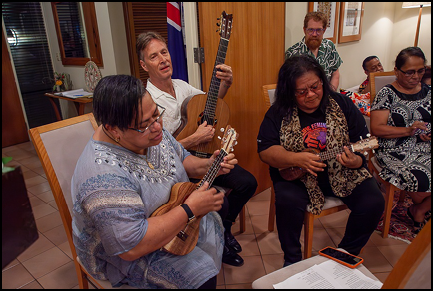
Guests then continued the farewell gathering over a buffet dinner, bringing an informal close to an evening devoted as much to personal friendship as to the diplomatic relationship between Australia and the FSM.
Leave a Reply