
August 31, 2026
Apia, Samoa – An MMR team has returned from the annual Scientific Committee meeting of the Western and Central Pacific Fisheries Commission (WCPFC), supporting the Cook Islands’ ongoing agenda for sustainable tuna fisheries in the Pacific towards the WCPFC 23 Annual Commission session in Vanuatu, in December.
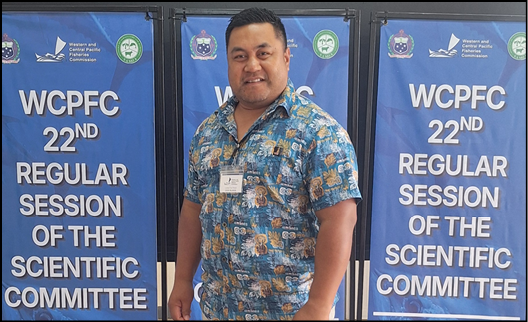
MMR’s Offshore Fisheries Director, Lualua Tua-Trood and Data Manager Tiare-Renee Nicholas returned this week from the 22nd Session of the WCPFC Scientific Committee (SC22), held in Apia, Samoa from 11–19 August 2026. The Scientific Committee meeting is one of several preparatory events ahead of the regular annual WCPFC session.
The Cook Islands delegation joined fisheries scientists and representatives from across the Pacific and beyond to consider the latest scientific information on the region’s major tuna fisheries and provide advice that will support future management decisions at the December meeting.
Tua-Trood said the increasingly sophisticated scientific work undertaken through WCPFC is essential to ensuring the Pacific uses the best available scientific information, maintains robust peer review processes, integrates the use of emerging technologies, and continuously improves stock assessments and research methods.
“For the Cook Islands, the value of this work ultimately lies in turning robust science into effective management decisions. Tuna fisheries are fundamental to our economy and communities, and we need management systems that are precautionary, responsive to changing stock conditions, and capable of dealing appropriately with scientific uncertainty.”
He outlined key outcomes from the SC 22:
– Updates on important new scientific analysis and advice on the Pacific’s major tuna stocks (skipjack, yellowfin, albacore and bigeye) and continued work to strengthen long-term harvest strategies. New 2026 assessments found that yellowfin tuna remains in a relatively strong position and is neither overfished nor experiencing overfishing. The Cook Islands supported using the latest assessments as the best available scientific information while recognising the need to continue addressing identified scientific uncertainties.
– Progress towards a management procedure for bigeye tuna, with the Cook Islands supporting a precautionary approach that is tested against a broad range of possible stock conditions.
- For South Pacific albacore, the management procedure was run for the first time in 2026, producing an annual catch level of 56,096 tonnes for 2027–2029 for the fisheries covered by the management procedure.
– Skipjack tuna indicators show that the stock remains close to its management target and is performing broadly within the range anticipated when its management procedure was developed. Scientists are continuing to improve the information used to monitor the stock and to examine how future climate-driven changes may affect the fishery.
He said, for the Cook Islands, “a central message emerging from SC22 is that the region’s major tuna stocks remain healthy and capable of supporting important fisheries, but maintaining that position requires continued investment in science and a willingness to translate that science into timely management action.”
Post-meeting, the Ministry of Marine Resources will continue participating actively in the WCPFC harvest strategy process and advocating for management arrangements that are precautionary, scientifically robust and responsive to the particular circumstances and aspirations of Pacific Small Island Developing States.
Leave a Reply