
October 17, 2026
New York—The Federated States of Micronesia has called on the international community to strengthen climate action, increase financial assistance to vulnerable countries, and fulfill existing commitments ahead of the 31st United Nations Climate Change Conference (COP31).
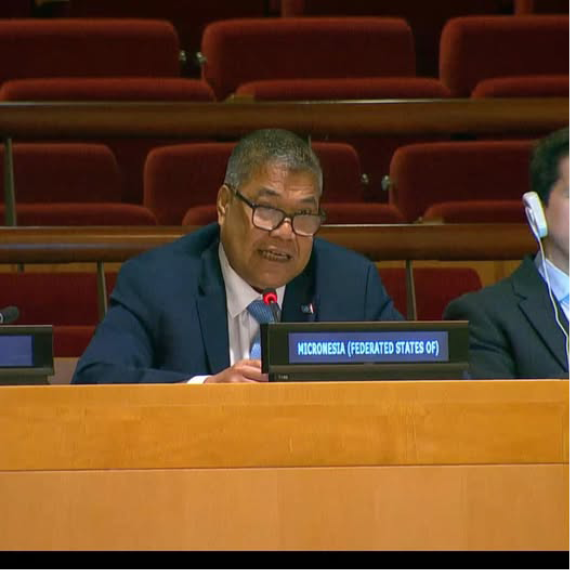
FSM Permanent Representative to the United Nations Ambassador Jeem Lippwe delivered the appeal on October 16 during a special event convened by the President of the UN General Assembly under the theme “A Planet Fit for the Future: Restoring Trust through Climate Action.”
Lippwe told delegates that climate change is already affecting the FSM’s coastlines, freshwater supplies, infrastructure, and livelihoods, making international action an immediate necessity rather than a matter for future generations.
“For my country, COP31 represents a critical opportunity to advance the action necessary to safeguard our people, preserve our homeland, and secure a viable future for generations to come,” he said.
Although the FSM is responsible for stewardship of a vast ocean area, Lippwe said its islands remain particularly vulnerable to rising sea levels and other consequences of climate change.
He described coastal erosion, saltwater contamination of freshwater resources, and threats to ecosystems and infrastructure as challenges that extend beyond economic development to the country’s cultural heritage and national identity.
“For us, climate change is not a future challenge. It is a present reality with profound implications for our sustainable development, cultural heritage, and national identity,” he said.
Lippwe called for stronger adaptation measures, improved disaster preparedness, and greater investment in systems capable of warning communities about approaching hazards.
He identified multi-hazard early warning systems as among the most practical and cost-effective measures available to protect lives and reduce losses from climate-related disasters.
Such systems, he said, must reach remote communities and incorporate both scientific expertise and traditional local knowledge.
The Ambassador also emphasized the need for international climate financing that vulnerable countries can access without taking on additional debt.
He called for funding that is predictable, sufficient, and provided through grants rather than loans, arguing that countries contributing relatively little to global greenhouse gas emissions should not bear additional financial burdens to address the consequences.
“Vulnerable countries should not be compelled to assume additional debt in order to respond to a crisis they did little to create,” Lippwe said.
His remarks reflected the FSM’s longstanding position that climate financing must account for the particular circumstances of small island developing states, whose limited resources and exposure to climate hazards make adaptation especially difficult.
Lippwe also warned that adaptation measures alone cannot adequately address the climate crisis.
He called for immediate reductions in greenhouse gas emissions to preserve the international goal of limiting global temperature increases to 1.5 degrees Celsius above pre-industrial levels.
In particular, he urged rapid reductions in methane and other short-lived climate pollutants, which contribute significantly to global warming.
“At the same time, adaptation cannot substitute for mitigation,” he said. “Preserving the 1.5°C goal requires ambitious and immediate action, including rapid reductions in methane and other short-lived climate pollutants.”
The Ambassador concluded by urging countries preparing for COP31 to demonstrate greater international solidarity and translate previous climate commitments into concrete results.
“As we look toward COP31, we call for renewed solidarity, strengthened support for vulnerable countries, and the full implementation of commitments already made,” he said.
“Let COP31 be remembered as the moment when the international community matched the urgency of the climate crisis with meaningful action.”
Leave a Reply