
October 15, 2026
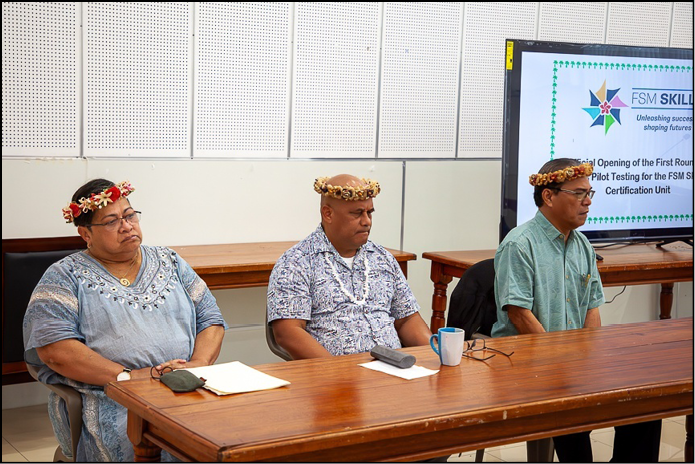
Pohnpei, FSM — The Federated States of Micronesia officially opened its first round of testing under the newly established FSM Skills Certification Unit (SCU) during a ceremony at the Pohnpei Governor’s conference room, introducing a national system intended to assess and certify workers’ practical abilities according to internationally recognized occupational standards.
President Wesley W. Simina, Pohnpei Governor Stevenson A. Joseph, College of Micronesia-FSM President Dr. Theresa Koroivulaono, and SCU Director Xavier Yarofmal addressed the gathering, which included FSM Cabinet members, government officials, educators, technical specialists, and COM-FSM students preparing to participate in the first round of testing.
The initial assessments are scheduled for October 19 through 23, with approximately 45 college graduates expected to participate in five occupational categories.
The certification system is designed to provide workers with formal recognition of their demonstrated skills, whether those abilities were acquired through formal education, workplace experience, or other means. The objective is to improve employment opportunities, give employers greater confidence in workers’ qualifications, and make FSM occupational certifications more widely recognized at home and abroad.
In his opening presentation, SCU Director Xavier Yarofmal explained that the unit was established through the World Bank-financed Skills and Employability Enhancement Project (SEE Project), implemented by the FSM National Department of Education in partnership with the Department of Resources and Development.
The unit currently operates under the Department of Resources and Development and received accreditation in May 2026 from the National Accreditation Center under ISO/IEC 17024:2012, an international standard governing organization that certifies individuals’ professional competencies.
Yarofmal said the certification system is intended to ensure that workers’ skills are recognized, credible, aligned with labor market requirements, and comparable to international standards.
The first five occupational certification categories are PC Repair and Support Technician, Residential Electrician, HVAC Technician specializing in refrigeration and air conditioning, Consumer Electronics Service Technician, and Telecommunications Technician covering fiber-optic and wireless technologies.
Four additional categories will be introduced during subsequent rounds of pilot testing: Tourism and Hospitality Worker, Agriculture Worker, Bookkeeping, and Skilled Construction Worker.
Altogether, the program plans to test nine occupational certification schemes over three rounds.
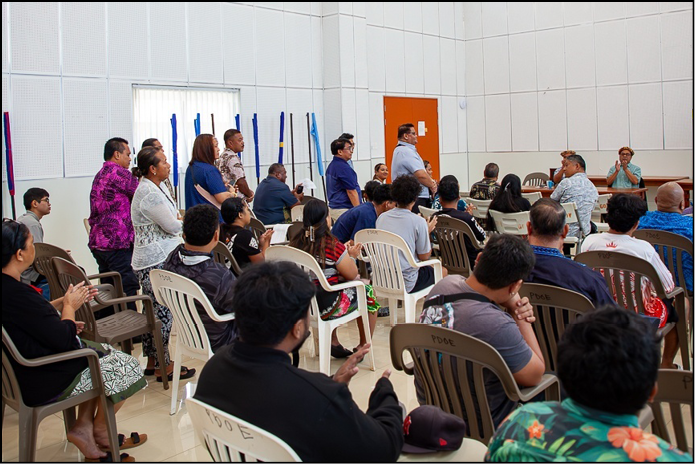
Yarofmal said the first assessments will involve faculty members from COM-FSM’s Career and Technical Education Center and National Campus, who will serve as assessors.
President Simina emphasized that skills certification serves a different purpose from traditional academic qualifications.
“An academic qualification generally recognizes the successful completion of a course or program of study,” he said. “Skills certification serves a different complementary purpose.”
He explained that certification verifies whether individuals can demonstrate the competencies required to perform particular jobs, regardless of how they acquired those skills.
“A credible skills certificate must therefore reflect what workers can actually do, not simply what they have studied,” Simina said.
The President said the initial testing will also help determine whether the system’s occupational standards, assessment procedures, quality assurance measures, and administrative arrangements are effective or require improvement.
He stressed that the participation of employers and experienced industry professionals will be essential to the system’s long-term credibility.
Employers, he said, should help develop occupational standards, evaluate assessment procedures, and eventually recognize certifications when making hiring and promotion decisions.
“When certification has real value in the workplace, more people will be motivated to have their skills assessed,” he said.
Simina also connected the initiative to concerns about youth unemployment. During a recent community outreach meeting with FSM citizens in Hawaii, he said, participants asked what the national government was doing to address the problem.
“This initiative is one of such answers,” he said.
He called for continued cooperation among national and state governments, COM-FSM, and private employers to ensure that the certification system survives beyond the World Bank-financed project’s completion.
“Our goal is to provide a trusted national service that continues to serve our people long after this project ends,” Simina said.
Governor Joseph offered a candid account of his initial reaction to the initiative, saying he had questioned whether it would duplicate other workforce development programs already operating in the FSM.
“When I heard that it was related to skills, in my mind I’m saying, here we go again,” Joseph said, recalling his first discussions with the SCU director.
He said a subsequent explanation convinced him that the certification system was not simply another overlapping program but an important addition to existing skills training efforts.
Joseph urged those responsible for the initiative to ensure that it becomes a lasting part of the FSM’s education and workforce development system rather than disappearing when external financing ends.
“Let us not treat this as just another program, another project,” he said.
He expressed hope that the initiative could eventually become a permanent part of the education system.
Joseph also called for greater recognition of students whose strengths lie in practical work rather than conventional classroom learning.
He said educators should recognize that students have different abilities and help them pursue educational and career paths suited to those strengths.
“While we’re teaching our children math, English, literature, and all these core subjects that we’ve all gone through the education system, let us teach them life skills,” he said.
The Governor also addressed the increasing use of artificial intelligence, describing it as both a useful tool and a potential danger if people become overly dependent on it.
“Machines are supposed to be doing what humans tell them. Not machines telling humans what to do,” Joseph said.
COM-FSM President Dr. Theresa Koroivulaono welcomed the certification initiative as an extension of the College’s existing commitment to technical education and workforce preparation.
She said the College’s Career and Technical Education Center provides certificate and degree programs, customized training, and continuing education designed to meet community and workplace needs.
The certification initiative, she explained, will help connect the College’s training programs with clearly defined occupational standards and identify areas where workers require additional instruction.
Koroivulaono also announced that she had asked the Dean of the Career and Technical Education Center to reactivate the College’s Industry Advisory Committee, which previously brought together private-sector representatives, government officials, and community members to participate in program evaluation and development.
She said closer cooperation with employers would help ensure that the College’s programs respond to actual workforce requirements.
As examples of current technical training activities, Koroivulaono said 60 FSM Telecommunications Corporation technicians from all four states have been participating in a telecommunications training program since the summer of 2026. Participants are expected to earn certifications in several technical and workplace safety areas upon completing their training.
She also described a five-day training program involving 24 participants from Pohnpei and Chuuk who are learning to use QGIS geographic information system software with instruction provided by a University of Guam specialist.
Koroivulaono said the College is also experimenting with artificial intelligence in its learning management system, including a pilot application intended to provide students with immediate feedback on assignments. She said COM-FSM adopted an AI policy in August 2025.
Turning to the broader employment situation, she said the FSM and other Pacific Island countries continue to experience shortages of qualified tradespeople, including electricians, plumbers, carpenters, and construction workers.
She also acknowledged that wage differences contribute to the movement of skilled workers overseas, making it increasingly important for the FSM to strengthen connections between training, certification, and employment.
The College intends to expand apprenticeships, internships, and other practical training opportunities that can lead to permanent employment, she said.
Koroivulaono thanked the faculty members who have taken on additional responsibilities as assessors and examiners for the certification initiative and asked them to stand for recognition during the ceremony.
The first round of testing represents the beginning of a broader effort to establish a national system through which workers can demonstrate their competencies and receive formal certification without relying exclusively on academic credentials.
While the pilot will initially concentrate on five technical occupations, officials said future testing will expand into other fields, with the eventual goal of providing workers throughout the FSM with access to occupational certification.
President Simina formally declared the testing open, setting the stage for the first group of applicants to undergo assessments beginning October 19.
Leave a Reply