
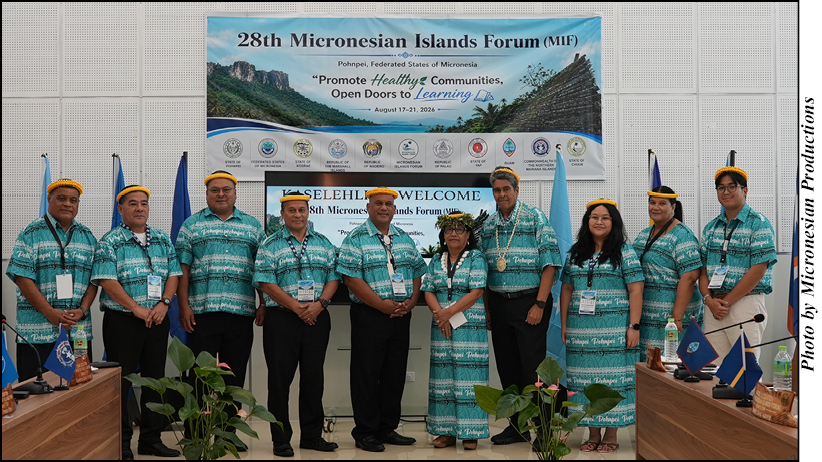
August 19, 2026
Pohnpei, FSM — Leaders and representatives from across Micronesia opened the 28th Micronesian Islands Forum in Pohnpei Wednesday with calls for stronger cooperation on health and education, but a broader message repeatedly emerged from their statements: regional discussions need to produce practical results.
From air and sea transportation to energy security, climate change, health care, workforce development and ocean protection, speakers returned repeatedly to problems that cross jurisdictional boundaries and cannot easily be addressed by individual island governments acting alone.
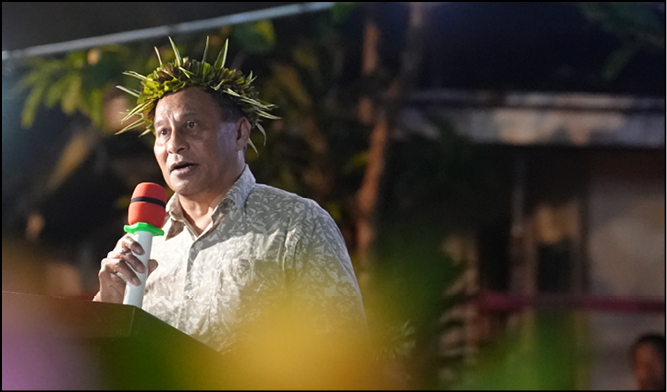
Pohnpei Governor Stevenson Joseph, who assumed the chairmanship of the Forum from Republic of the Marshall Islands President Hilda Heine, set that tone early.
“As we deliberate on the common issues we share, let’s focus and find solutions, tangible, practical solutions, and most importantly, put those solutions into action,” Joseph told the gathering.
The Forum is meeting under the theme “Promote Healthy Communities, Open Doors to Learning.”
Joseph said the theme focuses attention on two sectors that are essential to social and economic development but argued that governments too often accept existing health and education systems rather than make difficult changes.
He focused particularly on noncommunicable diseases, saying Micronesia’s health systems remain largely reactive, devoting enormous resources to treating people after they become ill rather than preventing disease.
“We must shift our focus and our resources to prevention,” he said, pointing to clean water, healthier local nutrition and early screening as investments that cost far less than chronic disease treatment and off-island medical referrals.
Joseph made a similar argument about education, asking whether Micronesian schools are providing young people with skills that match the actual needs of island economies. He called for greater emphasis on technical fields including sustainable aquaculture, mechanics, maritime skills and technology, along with closer partnerships with the private sector.
Climate change, he said, can no longer be treated as an occasional emergency. Drought, rising seas and other effects must instead be incorporated into development plans, budgets and infrastructure projects as permanent realities.
Whipps calls for a more action-oriented MIF
Palau President Surangel Whipps Jr. carried Joseph’s call for implementation further, arguing that the Micronesian Islands Forum itself should become the mechanism through which regional political commitments are turned into results.
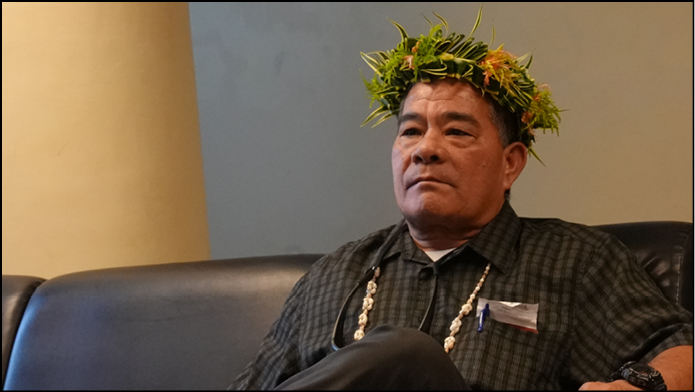
Whipps recalled the dispute five years ago that brought the Micronesian countries close to withdrawing from the Pacific Islands Forum after Micronesia’s candidate for Secretary General was passed over. The resulting reforms under the Suva Agreement, he said, demonstrated what Micronesian unity could accomplish.
“Proof that when Micronesia speaks with one voice, the region listens,” Whipps said.
He said designated representatives had reviewed the terms of reference of 14 MIF committees and found overlap, leading to recommendations that education and workforce development be combined, tourism, trade and transportation be brought together, and environmental, climate and ocean work be better coordinated. Work was also proposed toward terms of reference for a regional climate change committee.
Whipps said the reforms point toward a larger role for the MIF.
“We have the Micronesian Presidents’ Summit, where we as leaders set a direction,” he said. “But the Micronesian Islands Forum should be where that direction becomes action. Not a parallel conversation, but an implementing one.”
He said the wider Pacific does not lack ideas or communiqués but sometimes suffers from a gap between what leaders decide and what actually reaches their people.
Whipps, who was scheduled to leave Pohnpei ahead of the Pacific Islands Forum Leaders Meeting in Palau, urged Micronesian leaders to arrive at that meeting already aligned on regional priorities.
Ocean stewardship was among those priorities. Whipps said it was a Micronesian responsibility long before ocean conservation became a prominent international cause and called for a coordinated Micronesian position on the Unlocking Blue Pacific Prosperity initiative.
He also identified transportation and energy as foundations on which many of the region’s other ambitions depend.
“Better inner island and interstate transportation is not a project alongside our economic goals,” he said. “It is a precondition for achieving them, whether in tourism, trade, or access to health and education.”
Whipps noted that while individual governments have established renewable energy targets, Micronesia does not yet have a shared renewable energy ambition comparable to its regional commitments on ocean stewardship and climate resilience. He called on MIF committees dealing with transportation and energy to produce practical work plans rather than additional studies.
He also called for greater regional coordination against illegal, unreported and unregulated fishing, transnational crime and drug trafficking, and for improved access to climate finance and adaptation funding.
Palik calls north-south transportation essential to FSM development
Representing the FSM National Government in place of President Wesley Simina, Vice President Aren B. Palik placed transportation, energy, ocean protection, climate change, health and workforce development among the FSM’s regional priorities.
Palik said the FSM’s tourism sector has long depended heavily on the east-west aviation corridor and United Airlines’ island service, leaving the country vulnerable to limited access and high travel costs.
“If we truly want to unlock the economic potentials of our islands, we must think beyond the traditional corridors,” he said, calling for development of north-south connectivity within the region.
On ocean protection, Palik said the FSM has continued marine spatial planning and is working with partners on area-based management and marine protected area proposals. He said individual national efforts are insufficient to confront threats to the ocean and that Micronesia’s collective action and unified voice remain its greatest strength.
Energy security has taken on additional urgency following the recent fuel crisis, Palik said. He called for accelerated renewable energy development, more resilient infrastructure and regional cooperation, including bulk fuel procurement, shared technical expertise and coordinated investment.
The FSM is targeting 70 percent renewable energy by 2030, 80 percent by 2035 and net-zero emissions by 2050, he said.
Palik also called for regional investment in institutions that train health professionals, saying Micronesia needs to develop more of its own health workforce while upgrading health facilities that have reached the end of their useful lives.
He urged MIF members to support gender equality initiatives and recommended endorsement of the Kamorale Declaration from the recently concluded Micronesian Ministerial Women’s Conference.
On education, Palik said skills development is more than an educational issue and is central to job creation, nation building and economic growth. He pointed to international accreditation of the FSM Skills Testing and Certification Unit and said regional cooperation could help align qualifications and expand opportunities for workers across borders.
Heine urges revival of regional purchasing proposals
Marshall Islands President Hilda Heine also called for practical regional cooperation, particularly in education, energy, medicine procurement and transportation.
Heine said Micronesia should strengthen vocational education and revive earlier regional efforts to train skilled tradespeople, including work begun through Palau Community College. She advocated cross-border educational pathways, digital literacy, science and technology, entrepreneurship and lifelong learning.
She announced that the Marshall Islands will host the third Conference of Pacific Education Ministers in April 2027, which she said will be the first Pacific Education Ministers meeting held in Micronesia. Heine said RMI hopes the meeting will be approached as an opportunity for collective Micronesian leadership rather than solely as a Marshall Islands event.
On climate change, Heine called for continued defense of the 1.5-degree Celsius temperature limit and a transition away from fossil fuels, particularly by major emitters. She endorsed Whipps’ proposal for a 100 percent renewable energy goal for Micronesia and suggested establishing target dates.
She also called for Micronesia to use its combined purchasing power.
Regional bulk purchases of medicines and medical supplies could improve the sustainability of health systems, she said, while the same principle could apply to fuel.
Heine noted that Micronesian leaders agreed in 2024 to develop a regional energy security plan and explore bulk fuel procurement, but said progress had stalled. The 2026 Pacific fuel crisis, she said, demonstrated the urgency of returning to the proposal.
Aggregating regional demand could strengthen purchasing power, improve prices, increase supply reliability and reduce transportation costs, she said. Similar cooperation could eventually be applied to renewable energy infrastructure.
Heine also called for air connectivity to be elevated to the political level and for ministers and officials to continue exploring more reliable and affordable services.
Nauru says airline expects FSM service by November
Nauru’s delegation offered perhaps the most specific transportation proposal of the opening statements.
Speaking on behalf of Nauru President David Adeang, Special Envoy Rennier Gadabu said Nauru Airlines expects to begin service to the FSM by November following the recent signing of a memorandum of understanding with the FSM.
Gadabu described aviation as an essential lifeline connecting Micronesians to families, education, employment, health care, trade, tourism and government services. Current regional travel, he said, remains costly and unreliable, sometimes requiring travelers to fly far outside Micronesia to reach another island relatively close to their own.
Nauru Airlines previously operated as far as Palau with Australian government support but now operates only as far as Majuro following the end of that funding. Gadabu said the airline has also held discussions with One Pacific Airways on possible cooperation.
Nauru proposed development of a regional aviation framework identifying priority routes and the actions required of participating governments, including work on traffic rights, airport access and passenger and cargo demand.
Nauru also expressed interest in joining the Micronesian Shipping Commission and offered to explore whether its two vessels could contribute to regional services. Gadabu said successful shipping cooperation would require coordinated schedules, sufficient cargo volumes and workable cost-sharing arrangements.
“Our discussions must lead to tangible outcomes,” he said. “We should leave this forum with agreed responsibilities, realistic timelines, and a mechanism for measuring progress.”
On health, Gadabu said Nauru is putting greater emphasis on prevention and physical activity in response to high levels of noncommunicable disease. Among its initiatives is a public service walk every Friday in which government employees are required to participate.
Successful health policy, he said, must extend beyond hospitals and clinics into schools, workplaces, sporting organizations, churches, families and communities.

Guam seeks regional cooperation on health, transportation and seabed mining
Guam’s representative, Rikki Rae Orsini, speaking on behalf of Governor Lou Leon Guerrero, said increasing global attention on Micronesia makes it increasingly important that Micronesians establish their own priorities.
“Our political relationships may differ, but the challenges before us do not stop at jurisdictional boundaries,” she said.
Orsini called transportation essential to regional prosperity and resilience and said Guam continues to seek relief from U.S. federal restrictions that limit its ability to attract additional international air service.
She said better connections could improve food security, business opportunities and movement of people, goods and expertise while increasing regional self-reliance.
Drawing on Guam’s experience during the COVID-19 pandemic, when Guam tested samples for neighboring islands and assisted with quarantine, medicines, treatment and protective equipment, Orsini advocated greater sharing of health and emergency personnel.
She also described Guam’s plans for a new medical campus, including a proposed veterans clinic that could potentially expand access to care for veterans throughout Micronesia.
Guam is seeking claims-processing capacity so regional veterans can obtain help navigating U.S. Department of Veterans Affairs benefits without traveling long distances.
“Our Pacific veterans should not have to cross an ocean simply to receive the services they need,” Orsini said.
She also devoted substantial attention to conservation and the growing outside interest in Micronesia’s ocean resources.
“Others may look at our islands and the oceans surrounding us and see strategic location and natural resources,” Orsini said. “But our home cannot be reduced to a balance sheet.”
On deep-seabed mining, Orsini said Leon Guerrero’s position is that development should pause until more is known.
“We need more science, we need more data, and until we have them, we need to pause,” she said.
Orsini said questions remain about environmental consequences, whether affected communities will have a meaningful role in decisions and who will ultimately receive the benefits while island communities bear the risks.
Guam asked the MIF to give attention to deep-seabed mining and called for additional independent science and data and greater engagement before activities move forward that could irreversibly alter the ocean environment.
Chuuk seeks regional action on lagoon oil threat
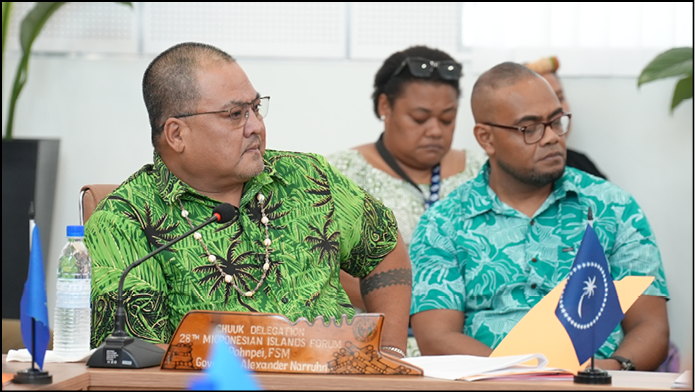
Chuuk Governor Alexander Narruhn linked the Forum’s health and education theme to environmental protection, infrastructure and opportunities for young people.
Narruhn described healthy communities as requiring healthy people, a healthy environment and strong culture. He called for stronger responses to noncommunicable diseases and mental health needs, clean water and food security, while protecting marine resources for future generations.
He said Chuuk has expanded its dispensaries and recently opened a dialysis facility, allowing more patients to receive treatment without leaving their families. Plans for a new hospital are also moving forward.
Narruhn renewed Chuuk’s call for regional assistance to address the threat posed by oil remaining in World War II shipwrecks in Chuuk Lagoon. He said more than six million gallons threaten the lagoon and its people.
On education, he called for early childhood and technical training and preparation for employment in blue and green economies.
Narruhn also sought support for development of a sports complex in Chuuk, saying the lack of such a facility has limited athletes and Chuuk’s ability to host regional sporting events.
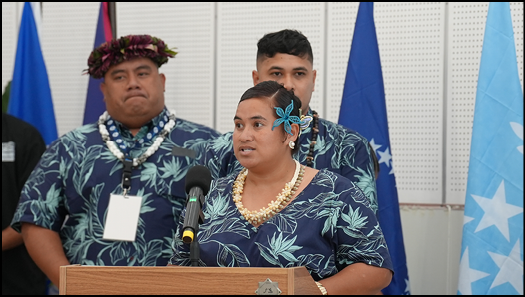
“The time for discussion has passed. The time for implementation is now,” Narruhn said.
States emphasize health, education and regional cooperation
Yap Governor Francis Itimai and Kosrae Governor Tulensa Palik also tied health and education to broader questions of regional resilience.
Itimai described climate change, health, education, preservation of cultural heritage and sustainable development as shared challenges requiring continued regional cooperation. He called for collaboration on public health, health infrastructure and capacity building while describing education as an engine for opportunity and innovation.
Palik similarly said health and education represent investments in Micronesia’s future. His statement linked quality health care, nutritious food, clean water and safe environments to resilient communities and called for continued cooperation against noncommunicable diseases and the health consequences of climate change.
Education, he said, should include not only classroom learning but knowledge passed through families, communities, culture and elders.
“The future of our islands depends on the choices we make today,” Palik said, calling on leaders to invest in children, protect community health and choose cooperation over isolation.
The CNMI’s representative, Clement Joseph Bermudes Jr., said the Commonwealth’s different political status does not diminish its connection to the rest of Micronesia.
He pointed to rising seas, natural disasters, energy security, economic development, tourism and aviation, health care, education and natural resource protection as challenges shared throughout the region. Recent powerful typhoons in the Marianas, he said, again demonstrated the importance of neighboring islands supporting one another and sharing resources and knowledge following disasters.
“Our political status may be different, but our challenges, our responsibilities, and our aspirations in specific communities are often the same,” Bermudes said.
Across the statements, differences in political status, geography and economic circumstances produced different priorities. Guam raised deep-seabed mining and veterans’ access. Nauru concentrated heavily on aviation and shipping. Chuuk sought assistance with the continuing threat from World War II wrecks. The FSM emphasized north-south transportation, renewable energy, climate and workforce development. The Marshall Islands pressed for regional purchasing and greater educational cooperation.
But the opening statements repeatedly returned to the argument that the region’s size and isolation make cooperation a necessity rather than simply an aspiration.
For Whipps, the approaching Pacific Islands Forum Leaders Meeting in Palau offered an immediate test. He said Micronesia should arrive not seeking an opportunity to be heard, but having already agreed on its priorities.
“Micronesia does not need to arrive in Palau asking to be heard,” Whipps said. “We arrive having already done the work of speaking with one voice.”
For Nauru, the test was even more concrete: commitments should have responsibilities, deadlines and a way to determine whether they have been carried out.
And for Joseph, beginning his tenure as MIF chairman, the standard was established at the outset of the meeting: find practical solutions and put them into action.
Leave a Reply