
September 7, 2026
WENO, Chuuk — A social media post by United States President Donald Trump incorrectly identifying the Federated States of Micronesia and the Republic of the Marshall Islands as U.S. territories has now been raised directly with a senior U.S. official, with the United States reaffirming its recognition of FSM sovereignty.
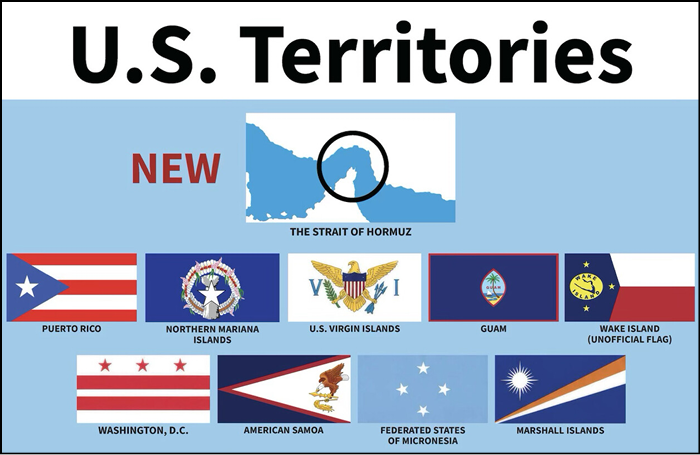
Trump posted a graphic to his Truth Social account on August 27 under the heading “U.S. TERRITORIES.” The graphic included the flags and names of the FSM and Marshall Islands alongside Puerto Rico, Guam, American Samoa, the Northern Mariana Islands, the U.S. Virgin Islands, Wake Island, and Washington, D.C. It also included the Strait of Hormuz, identified as “New.”
The FSM and Marshall Islands are not U.S. territories. Both are sovereign nations in free association with the United States under their respective Compacts of Free Association.
The distinction is more than a matter of terminology.
The FSM has its own Constitution, elected national and state governments, diplomatic relations with other countries, membership in the United Nations, and sovereignty over its territory. Its relationship with the United States under the Compact is close and unique, particularly in defense, migration, and economic assistance, but the Compact does not make the FSM a possession or territory of the United States.
The graphic remained on Trump’s Truth Social account as of September 7. An independent archive of Trump’s Truth Social posts recorded the August 27 posting and captured it again on September 5.
The apparent error drew some attention in U.S. and international media, although much of the coverage concentrated on Trump’s inclusion of the Strait of Hormuz as a new U.S. territory rather than on the status of the two freely associated Pacific nations.
The White House has separately promoted Trump’s assertions of U.S. control over the Strait of Hormuz amid the continuing conflict with Iran. Whatever political message was intended concerning the strait, however, placing the FSM and Marshall Islands under the same heading introduced an unrelated factual error into an official presidential communication.
For the FSM, the issue does not appear to have produced alarm that the United States is asserting a territorial claim over the country. There has been no indication from the U.S. government of any change in its recognition of the FSM as a sovereign nation.
But information concerning the political status of the FSM carries particular significance when it comes from the President of the United States.
The United States administered the islands that later became the FSM as part of the Trust Territory of the Pacific Islands after World War II. The FSM subsequently established constitutional government and entered into the Compact of Free Association with the United States. The relationship created by the Compact is therefore fundamentally different from the relationship between the United States and its territories.
FSM Secretary of Foreign Affairs Ricky Cantero told The Kaselehlie Press last week that the matter had not been raised with U.S. Deputy Secretary of State Christopher Landau during Landau’s visit for the Pacific Islands Forum. Cantero said there were more appropriate times and places to address such matters and indicated that an opportunity could arise during Landau’s subsequent visit to Chuuk.
That discussion apparently did take place.
According to a September 6 release from FSM Information Services, President Wesley W. Simina met with Landau in Weno, Chuuk, for bilateral discussions covering the Compact relationship, Typhoon Sinlaku recovery, infrastructure, defense projects, and other matters.
The government release did not specifically identify Trump’s post. It said only that Simina “addressed concern over recent inaccurate public commentary regarding the FSM’s political status.”
According to the release, Landau reaffirmed U.S. respect for FSM sovereignty, while Simina emphasized the importance of that sovereignty and expressed appreciation for the continued mutual respect between the two countries.
The restrained exchange appears to put the matter in perspective. Nothing in the FSM government’s account suggests that either side treated the Truth Social graphic as an actual assertion of U.S. sovereignty over the FSM.
It does, however, leave the original error uncorrected in the place where it occurred.
As of September 7, Trump’s August 27 Truth Social post remained publicly available. The graphic itself contains no qualification explaining that the FSM and Marshall Islands are sovereign countries in free association with the United States.
For two countries whose political relationship with the United States is often poorly understood outside the Pacific, that distinction matters.
The Compacts provide the United States with extensive defense rights and responsibilities and give citizens of the freely associated states important rights in the United States. Those arrangements can make the relationship difficult to describe briefly. They do not, however, make either country a U.S. territory.
The posting therefore presents a problem considerably less dramatic than a threatened American takeover of the FSM, but one that is nonetheless significant: inaccurate information about a sovereign country was distributed to a large international audience by the President of the country with which the FSM has its closest political and strategic relationship.
President Simina has now raised the issue directly with the second-ranking official at the U.S. State Department. Landau’s response, according to the FSM government, was unequivocal: the United States respects the sovereignty of the Federated States of Micronesia.
Leave a Reply