
September 22, 2026
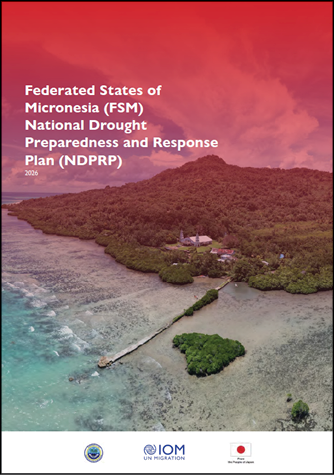
FSM – The Federated States of Micronesia (FSM) has taken an important step to strengthen drought preparedness and water security with the endorsement of its National Drought Preparedness and Response Plan (NDPRP). The Plan, officially endorsed on 22 August 2026 by the Government of FSM through the Department of Environment, Climate Change and Emergency Management (DECEM), provides a national framework for strengthening preparedness, response and resilience to drought events. Its development was facilitated by the International Organization for Migration (IOM), with support from the Government of Japan.
The NDPRP establishes FSM’s first comprehensive national framework for coordinated drought risk management at the national and state level, including across the four states of Chuuk, Kosrae, Pohnpei, and Yap. The Plan provides clear mechanisms for drought monitoring, early warning, preparedness, response, recovery, and coordination among national and state governments, municipalities, communities, and development partners.
FSM has experienced several major drought events over recent decades, including severe droughts in 1983, 1998, 2015-2016, and most recently during the 2023-2024 El Niño event. These events significantly impacted water supplies, agriculture, public health, education, and livelihoods, particularly in outer island communities where fresh water sources are limited, and communities rely heavily on harvested rainwater.
“The endorsement of the National Drought Preparedness and Response Plan reflects FSM’s commitment to proactive drought management and climate resilience,” said FSM DECEM’s Secretary Florian J. Yatilman. “By strengthening preparedness before drought emergencies occur, we can better protect our people, safeguard water and food security, and support our most vulnerable communities.”
The Plan is built around three core pillars: strengthening early warning systems, improving vulnerability and impact assessments, and enhancing drought mitigation, preparedness, and response measures. It establishes clear mechanisms for coordination among weather services, disaster management authorities, water utilities, health and agriculture sectors, and community-based disaster management committees. It also supports community-led planning and localized early action, particularly for remote and outer island populations.
“The Government of Japan is pleased to support this important initiative, which will strengthen water security and climate resilience in FSM,” said Nobuo Kagomiya, Ambassador of Japan to the Federated States of Micronesia. “Strong preparedness and risk reduction measures are essential as climate-related challenges continue to affect the Pacific region.”
The Plan’s development was supported through the Climate Resilient Community Water Services in the North Pacific Project drawing on extensive consultations with national and state government agencies, utilities, technical experts, traditional leaders, communities, and development partners across FSM.
“IOM is proud to support the Government of FSM in strengthening drought preparedness and resilience,” said Ewa Naqvi, IOM North Pacific Chief of Mission. “The National Drought Preparedness and Response Plan provides a practical roadmap for coordinated action that will help reduce drought impacts and improve water security for communities throughout the country.”
The NDPRP prioritizes the needs of people and communities particularly vulnerable to drought impacts including women, children, older persons, persons with disabilities, and households with limited resources. Implementation of the Plan will support enhanced drought monitoring, stronger communication systems, improved water resource management, increased community preparedness initiatives, and more effective response mechanisms before, during, and after drought events.
Read or download the complete issue of The Kaselehlie Press

Leave a Reply