
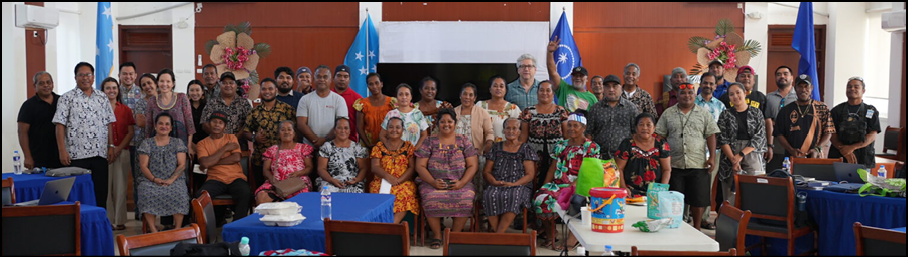
This milestone work, funded through the Green Climate Fund’s SAP020 project “Climate-Resilient Food Security for Farming Households Across the Federated States of Micronesia” and administered by the Micronesia Conservation Trust, delivered evidence-based, state-specific Food Security Policy Action Items to local stakeholders, not as top-down mandates, but as co-authored frameworks built from the voices and data of the communities they serve.
Building on Years of Collaborative Partnership
The April-May 2026 policy review meetings are the culmination of multi-year participatory action research that began in 2022 when the Rutgers team, led by James Simon, Distinguished Professor of Plant Biology in the School of Environmental and Biological Sciences (SEBS), was contracted to conduct the baseline assessment for the Green Climate Fund food security project. Since then, the food systems science team-an interdisciplinary research group based at SEBS, representing disciplines spanning agriculture, marine science, agribusiness, ethnobotany, nutrition, climate modeling, anthropology, environmental engineering and science communication has partnered with local NGOs and community organizations to survey more than 1,500 farming families and stakeholders across the FSM’s four states: Yap, Chuuk, Pohnpei, and Kosrae.
The team has partnered with the Federated States of Micronesia and the Micronesia Conservation Trust since 2021 and has worked on six food security related major projects, including the Green Climate Fund GCF SAP020 baseline assessment; FSM’s Third National Communication to the United Nations Framework Convention on Climate Change; the US Economic Development Administration Food Systems Solutions project; and Pohnpei State’s Food Security Policy and Food Production Master Plan.
The FSM, a Pacific island nation of 607 islands, faces an urgent food security crisis driven by climate change and a decades-long dependency on imported foods that replaced its once self-sustaining traditional food systems. The Rutgers team’s approach has centered community voice, cultural relevance, and indigenous knowledge at every stage of data collection and policy development. The 2025 Pohnpei State Food Security Policy, developed by the Rutgers science team in close partnership with the Pohnpei State’s Department of Resources and Development, served as a model for the state-specific frameworks now prepared for Yap, Chuuk, and Kosrae. All four state policies are structured around nine strategic goals encompassing local food production, food processing and supply chains, food safety and water security, technical training, neighboring island food security, nutrition and cultural awareness, food production policy management, import and investment policies, and community management.
Significance of the Work
The completion of state food security policy reviews across all four FSM states represents one of the most comprehensive, participatory, and evidence-based food policy development efforts yet undertaken for a Pacific island nation. The convergence of more than 1,500 mixed methods surveys, focus group and repeated in- person community convenings has produced an unprecedented body of original empirical evidence returned to the communities who generated it.
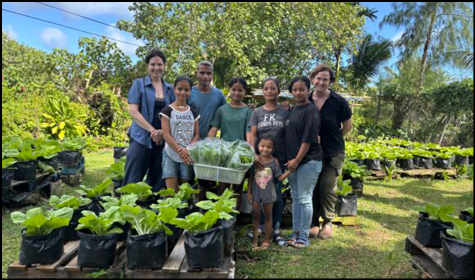
“So many people in our community have food related diseases like diabetes and heart disease. We started growing our own vegetables because we wanted healthy food for our children and we could not find it in the stores. Now we are growing for our family and for the community and we cannot keep up with demand,” said Carmen Muguy, a farmer in Yap State.
“At the national level, it is our responsibility to address the needs of the communities we serve. We appreciate and value our long-term partnership with the Rutgers team and their approach to working at the local level with stakeholders in all our FSM states,” said Elina Akinaga, FSM’s Secretary of Resources and Development.
“This work exemplifies what it means to do research with communities in support of their environmentally and culturally based food production goals,” said Simon, lead scientist for the Rutgers food systems research team in the FSM. “Data points in these policies came from FSM farmers, fishers, community leaders, and local organizations who generously shared their knowledge, aspirations, and lived experience. Our role is to ensure those voices shape the policies that will determine their food future.”
The nine-goal framework structuring each state’s Food Security Policy Action Items provides both comparability across states and sufficient flexibility to accommodate each community’s distinct agricultural resources, cultural priorities, geographic constraints, and community aspirations. As the final action items are refined through stakeholder review and formally adopted by each state government, they will mark a pivotal step toward climate-resilient, culturally grounded food sovereignty in the FSM and lay the foundation for the next phase of the partnership.
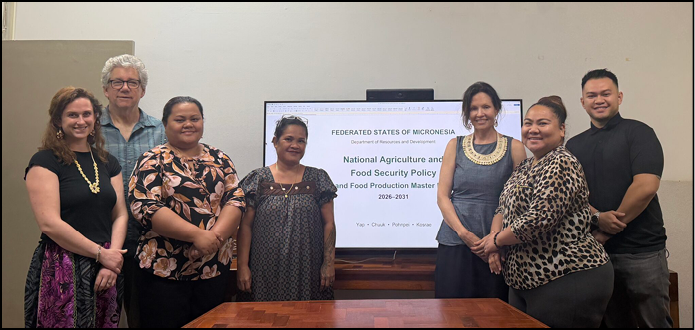
Building upon the four state food security policies, the Rutgers food systems science team is now developing the FSM National Agriculture and Food Security Policy and Food Production Master Plan 2026-2031 in close collaboration with the FSM National Department of Resources and Development and all four state governments.
About the FSM National Agriculture and Food Security Policy and Food Production Master Plan 2026–2031
Currently under development, the FSM National Agriculture and Food Security Policy and Food Production Master Plan 2026-2031 builds directly upon and harmonizes the four state-level Food Security Policies following their formal state approval, translating their shared vision into a coordinated national program of action aligned with the FSM Sustainable Development Plan 2024-2043. The plan’s operational centerpiece is the FSM Food Innovation Infrastructure Network: a nationally standardized, three-tiered system of Food Innovation Centers providing every FSM community with a structured entry point into the local food economy. Grounded in the same participatory action research approach, the national master plan addresses interstate food trade, national food safety certification, coordinated digital market infrastructure and the policy levers needed to attract the investment this transformation requires. The plan sets ambitious but community-validated five-year targets: a 50% increase in locally produced food available to FSM households, a 50% reduction in food import categories that can be produced within FSM, and hundreds of new food system jobs across all four states.
The interdisciplinary Rutgers food systems research team working in the FSM is co-led by Dena Seidel and Ramu Govindasamy and includes, Oscar Schofield, Yariv Ben-Naim, AJ Both, Roland Hagan, Tori Rosen, Lara Brindisi and Michael Balick (New York Botanical Gardens) and Iris Arbogast (University of Chicago). Additional Rutgers faculty supporting the development of FSM food security policies include James Shope, Dave Bushek, Nolan Lewin and Kevon Rhiney, and undergraduate students Lauren Koo, Olivia Finer, Ankora Sant’Angelo and Eamon Black.
Leave a Reply